
CPT 92015 is the most asked about and most written off line in optometry billing, and almost every guide answers the wrong question. They explain what the code means. The meaning was never the problem.
The code does not change from visit to visit. What changes is who pays it. Refraction is not really a coding decision, it is a payer decision wearing a code number, and once you see it that way the confusion mostly disappears.
Here is the rule that makes 92015 simple. Refraction is not a medical benefit. Medicare and nearly every medical carrier will not pay it. That leaves exactly two places the charge can land, the vision plan or the patient. Everything else is a detail on top of that one fact.
And because a patient's coverage and the reason for the visit are both known at the front desk, the payer for the refraction is knowable before the exam even starts. That is the moment GIMBL is built for, flagging where the refraction should go at check in, before the claim exists.
What CPT 92015 refraction billing actually covers
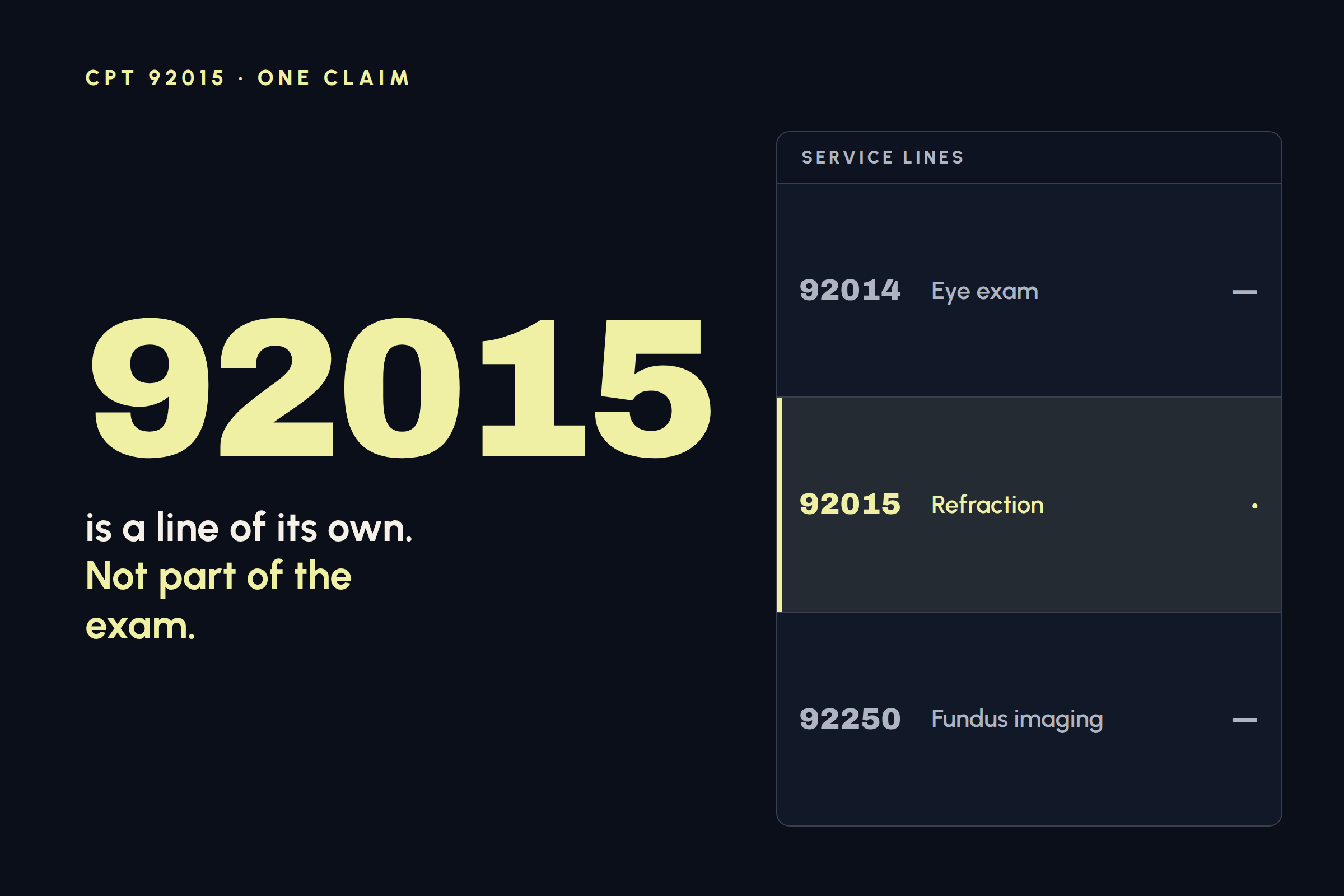
CPT 92015 is the determination of refractive state, the measurement of how the eye focuses light so you can set the correct glasses or contact lens prescription. It is reported in addition to whatever exam was performed, whether that is an eye visit code in the 92000 series or an evaluation and management code in the 99000 series.
Two things about the code matter more than its definition. First, it is a service in its own right, not a bundled part of the exam, so billing it alongside the exam is correct, not double dipping. Second, it is never part of a global surgical package, so a refraction performed during a post operative period is its own billable service. Neither of those is where practices lose money. The money is lost on where the charge gets sent.
Key Takeaway
92015 is its own service, billed in addition to the exam and never inside a surgical global. The hard part is not coding it, it is deciding who pays it.
Why 92015 is a payer decision, not a coding decision
The reason refraction generates so many denials is that the same code produces completely different outcomes depending on the payer, and staff treat it as one rule when it is really several. So start from the one carrier that is not ambiguous.
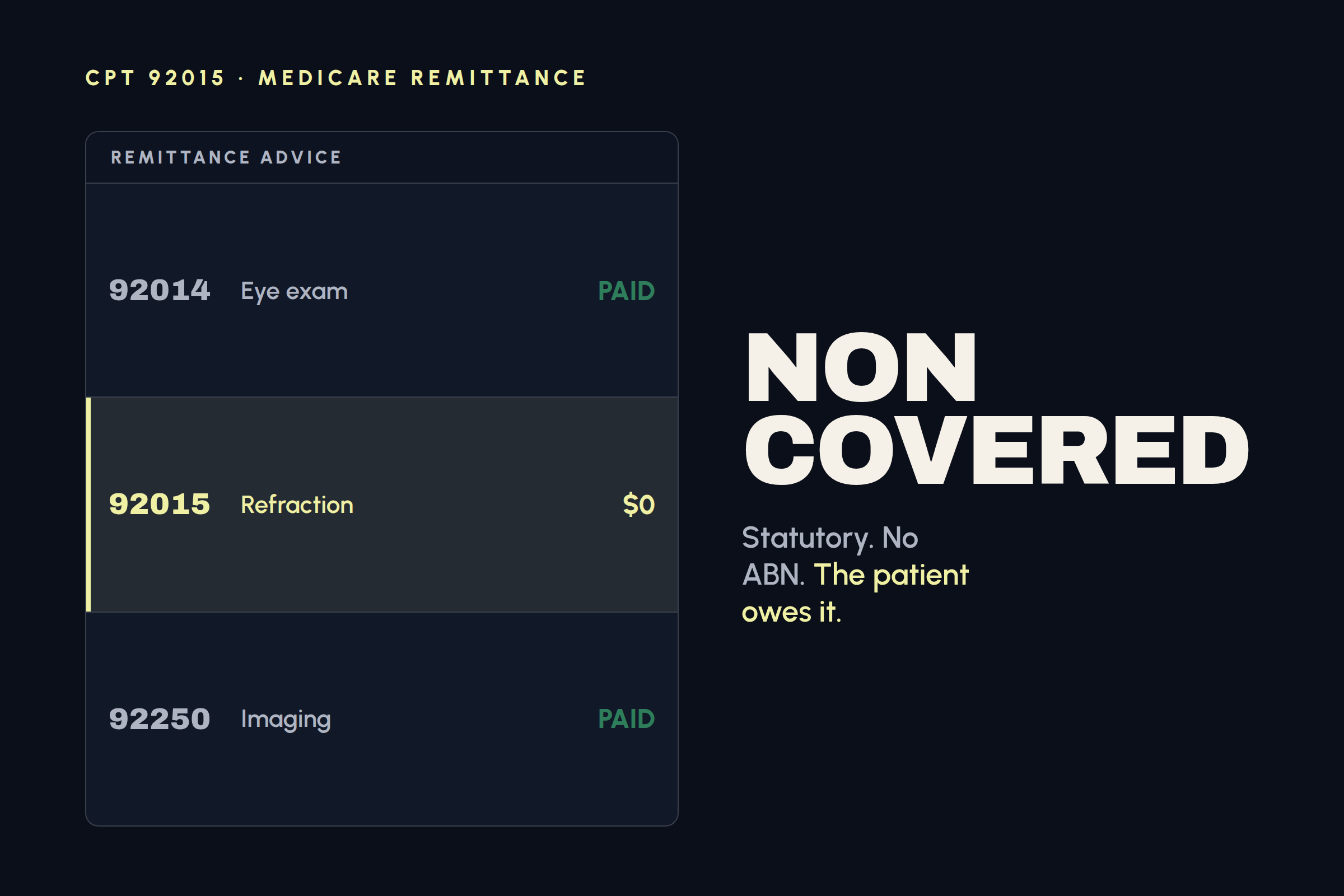
Medicare Part B and Medicare fee for service do not cover refraction, full stop. Because it is a statutory non covered service rather than something denied for medical necessity, an Advance Beneficiary Notice is not required, and the patient is simply responsible for the charge. The Academy's coding guidance is explicit on this point. So for any traditional Medicare patient, the refraction goes to the patient, collected at the time of service, every time.
Insight
The costly mistake is almost never miscoding 92015. It is sending the charge to a payer that will never pay it, then writing it off when the denial comes back weeks later.
The two lanes refraction can travel
Once you accept that the medical carrier is not paying for refraction, the decision collapses into two lanes, and your only job is to know which one applies before the visit.
The first lane is the vision plan. Plans like VSP and EyeMed generally cover refraction as part of the routine benefit, since identifying myopia, hyperopia, and presbyopia is exactly what a routine exam is for. Coverage is usually limited to once a year or once every two years, so the number to confirm is the frequency, not whether it is covered at all. Our VSP billing guide covers how the refraction rides the routine exam on that side.
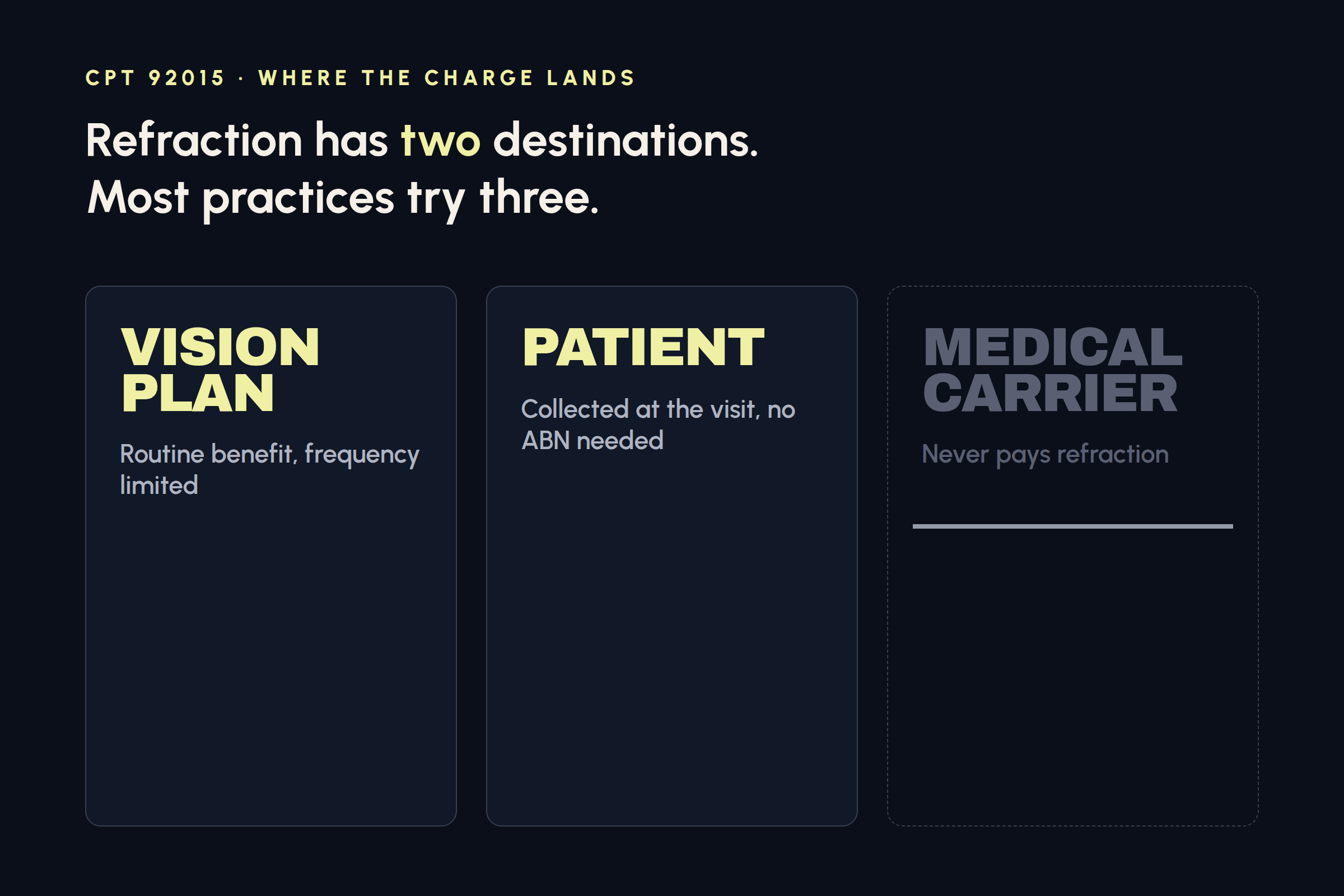
The second lane is the patient. When no vision plan is in play, or the plan's frequency is already used, the refraction is the patient's responsibility, collected up front. This is normal and compliant. Charging the patient for a service their insurance does not cover is not a workaround, it is the correct handling.
Commercial medical plans are the trap in the middle. A few have an allowable for refraction tied to a specific diagnosis, but treat that as the exception you verify in the contract, not the default you assume. On a participating commercial contract, a non covered refraction can be a contractual adjustment you are not permitted to bill the patient for, which is why reading the participating provider agreement matters before you decide the charge is collectible.
Key Takeaway
Vision plan or patient. Those are the only two destinations that actually pay for refraction. The medical carrier is not a third option, it is a dead end.
Who pays for refraction, and when that gets decided
Here is where the whole thing comes together. Every input that decides who pays for the refraction is already known when the patient walks in. Their coverage is on file. The reason for the visit is on the schedule. So the correct destination for 92015 can be set at check-in, before a single code is entered.
| What the patient has | What the visit is | Where 92015 goes |
|---|---|---|
| Vision plan, benefit open | Routine | Vision plan |
| Vision plan, frequency already used | Routine | Patient, collected at the visit |
| Traditional Medicare, no vision plan | Any | Patient, no Advance Beneficiary Notice needed |
| Vision plan plus a medical complaint | Medical | Exam to the medical carrier, 92015 to the vision plan |
| No vision plan | Medical | Patient, unless the contract makes it a write off |
The refraction never actually changes. Only the pocket it is collected from does.
The failure mode is making this call after the explanation of benefits arrives. By then the write off is already booked, or the patient has been gone for weeks and is far harder to collect from. The payer side has its own clock too. Davis Vision allows sixty days from the date of service, so a refraction that sat on the wrong claim can run out of time before anyone has looked at the remittance.
Never bundle refraction into a surgical global to avoid a separate charge, and never bill it as covered when the contract says it is not. Both are billing the claim to a reality that did not happen, and both draw audits, not revenue.
Key insight:
Deciding refraction at intake turns a recurring denial into a charge that simply gets paid. Deciding it on the remittance turns it into a write off.
CPT 92015 modifier rules, frequency, and the small print
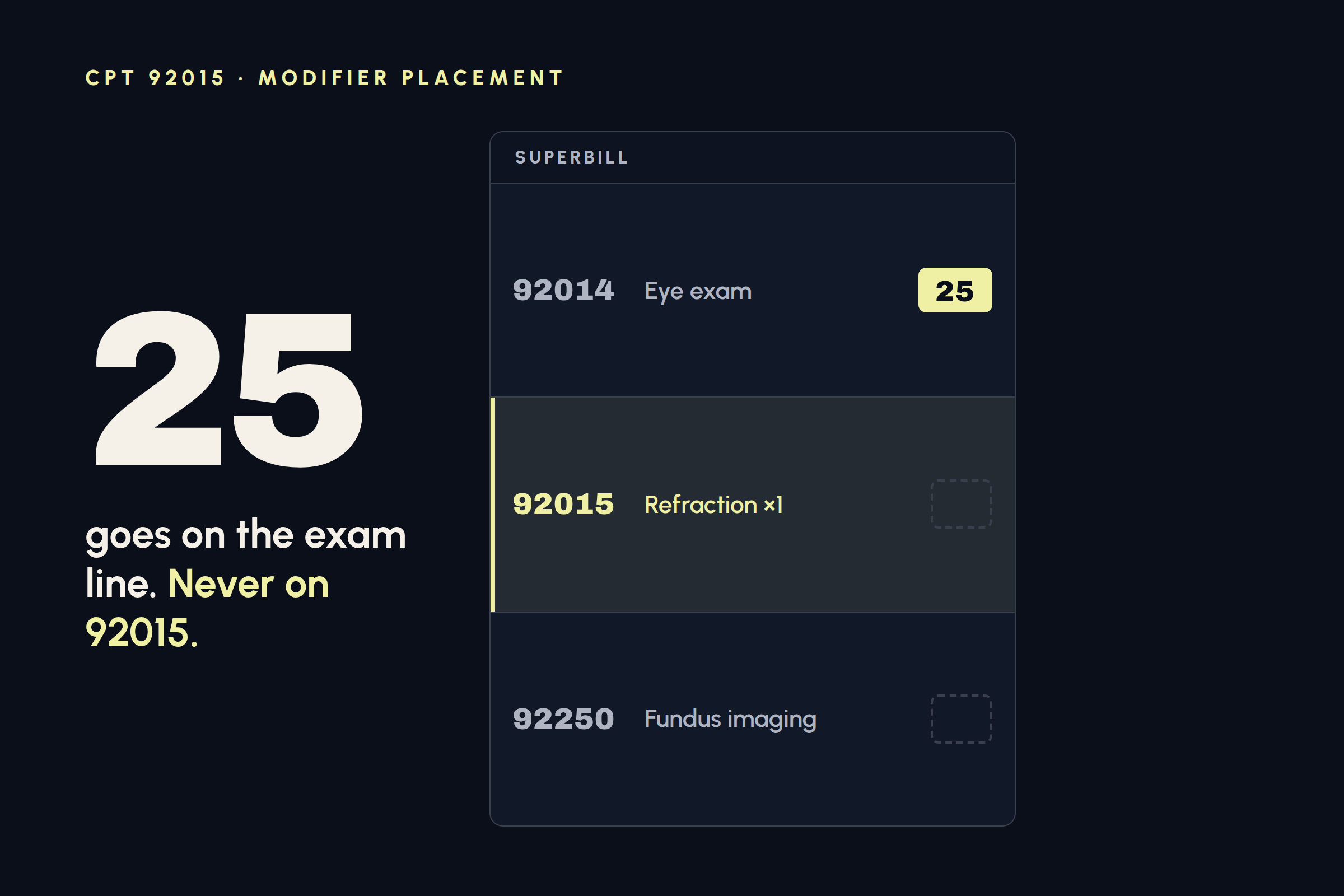
The modifier question comes up constantly, so keep it simple. 92015 is inherently a bilateral service, so it is reported once per encounter, not once per eye. The modifier that usually appears on a refraction day sits on the exam or E/M service, not on 92015 itself, most often a 25 on a significant, separately identifiable evaluation performed the same day. Lean on your payer's own policy and the AOA coding resources rather than applying one carrier's modifier habit to every claim.
Two more small rules save denials. An autorefraction is not billable as 92015 until it has been refined into a manifest refraction, so the automated reading alone does not earn the code. And reimbursement itself varies by locality and by facility versus office setting, so when you want the exact allowed amount, the CMS Physician Fee Schedule lookup is the source of truth, not a number copied from another practice.
Key insight:
92015 is fixed. The only real decision is vision plan or patient, because the medical carrier never pays refraction, and that decision is made at the front desk.
Which codes and diagnoses refraction billing travels with
Refraction does not ride alone. It sits next to the exam, the 92002 through 92014 eye visit codes or the 99202 through 99215 E/M codes, and it is supported by the diagnosis that carries the visit. For a full breakdown of those eye exam codes, new versus established and intermediate versus comprehensive, see the guide to CPT codes for eye exams.
A routine diagnosis such as Z01.00 or Z01.01, or a refractive error in the H52 family, keeps the refraction firmly in the vision lane where it belongs. A complaint changes the opening. If the patient booked because things looked blurry, the visit started on the code for blurry vision, and once the exam finds uncorrected refractive error the H52 code replaces it rather than joining it. The full code and diagnosis reference is in the vision billing codes guide, and where two plans are both in play the order they are asked in is set out in coordination of benefits in optometry.
Key insight:
The diagnosis does not decide who pays for the refraction. It confirms which lane the visit was already in.
The bottom line on CPT 92015
92015 stops being difficult the moment you stop treating it as a coding puzzle. The code is settled. The only live question on any given visit is which of two pockets pays for the refraction, the vision plan or the patient, and that is a front desk decision that can be made before the claim is ever built. Everything upstream and downstream of that moment, from charge entry to denial follow up, sits in the optometry billing guide.
Key insight:
Getting the refraction right at intake is not a coding improvement. It is the difference between a charge that gets paid and one that was never going to be.
Route the refraction before the claim exists
GIMBL checks eligibility on both the vision plan and the medical plan at intake, decides which one the visit belongs to, and builds the claim before the exam.
Start here: gimbl.io/auth/register
Frequently asked questions
Does Medicare cover refraction under CPT 92015?
No. Traditional Medicare Part B and Medicare fee for service do not cover refraction. Because it is a statutory non covered service rather than a medical necessity denial, an Advance Beneficiary Notice is not required, and the patient is responsible for the charge. Collect it at the time of service. Medicare Advantage plans may include a routine vision benefit that covers refraction, so those are verified separately.
Do you need a modifier for CPT 92015?
Usually not on the 92015 line itself. 92015 is a bilateral service billed once per encounter, so it does not take an LT, RT, or 50. The modifier that typically appears on a refraction day is a 25 on the exam or E/M service performed the same day, indicating a significant, separately identifiable service. Always confirm against the specific payer's policy rather than applying one carrier's rule everywhere.
Can you bill 92015 with an eye exam like 92014 or 99213?
Yes. Refraction is separately billable in addition to the exam, whether the exam is an eye visit code in the 92000 series or an E/M code. It is not bundled into the exam and it is not part of a surgical global. Reporting it alongside the exam is correct coding, not duplicate billing.
Who pays for refraction when insurance does not cover it?
The patient. When neither a vision plan nor a covering medical policy pays for refraction, the charge is the patient's responsibility and is best collected at the visit. For traditional Medicare patients no Advance Beneficiary Notice is needed because refraction is a statutory non covered service. On a participating commercial contract, check whether a non covered refraction is a contractual write off before billing the patient.
Is CPT 92015 covered by vision plans like VSP or EyeMed?
Generally yes. Vision plans such as VSP and EyeMed typically cover refraction as part of the routine exam benefit, since it is used to identify myopia, hyperopia, and presbyopia. Coverage is usually limited by frequency, often once a year or once every two years, so verify the remaining benefit during eligibility rather than assuming the cycle is open.