
A code does not choose a payer. The same eye exam code can bill to the vision plan or to medical, and the diagnosis is what decides.
Every optometry practice wants a clean list of vision billing codes, one column of numbers to bill and forget. The codes are the easy part. The hard part is that the same code can be paid by a vision plan on one visit and by a medical carrier on the next, and nothing on the code itself tells you which.
What moves a code from the vision lane to the medical lane is the diagnosis and the reason for the visit. A comprehensive exam coded to a routine diagnosis bills to VSP or EyeMed. The same exam coded to a medical condition bills to the medical carrier. Get that pairing wrong and the cleanest code in the world still denies.
This guide is a working reference to the CPT, HCPCS, and diagnosis codes optometry uses, organized the way claims actually run: what the code is, and which lane it belongs in.
Because that lane is set by the diagnosis chosen at check-in, before the claim exists, this is where GIMBL works. It flags the medical versus vision call at intake, so the code and the payer line up from the start.
The eye exam codes, 92000 series versus E/M
A routine eye exam is usually billed with the general ophthalmological service codes: 92002 and 92004 for new patients, 92012 and 92014 for established patients. Some vision plans instead accept the routine ophthalmological exam codes S0620 and S0621, which include the refraction. These, documented alongside the rest of eye care by the AOA, are the codes most people mean by vision billing codes.
For a full breakdown of each code, new versus established and intermediate versus comprehensive, see the complete guide to CPT codes for eye exams.
The alternative is the evaluation and management set, 99202 through 99215. These are used when the visit is a medical problem visit rather than a routine exam, and the level is driven by the documentation and medical decision making. Choosing between the 92000 series and the E/M series is not about which pays more. It is about which one the visit and the note actually support.
Key Takeaway
Routine exams run on the 92002 to 92014 series or the S codes. Medical problem visits run on the 99202 to 99215 E/M series. The visit type, not the payer you prefer, picks the family.
New to the code set? Start with what CPT codes are, then come back for the vision-specific breakdown.
Refraction, CPT 92015
Refraction is the code that generates the most questions, so it earns its own section. CPT 92015 is a separately billable service, and Medicare and most medical carriers do not cover it. That single fact sets its lane: refraction belongs on the vision claim, or it becomes the patient's responsibility.
When you bill the 92000 series exam, report 92015 separately. When a plan accepts the S0620 or S0621 routine exam codes, the refraction is already bundled in, so no separate 92015 is added. Sending 92015 to a medical carrier on a medical visit is a guaranteed denial, since the medical plan never pays it.
For the full breakdown, including modifiers, Medicare, and who pays when no plan covers it, see how to bill CPT 92015.
Key Takeaway
Refraction, 92015, is billed to the vision plan or the patient, never to Medicare or a medical carrier. On a bundled S code it is already included.
Materials, fitting, and optical HCPCS codes
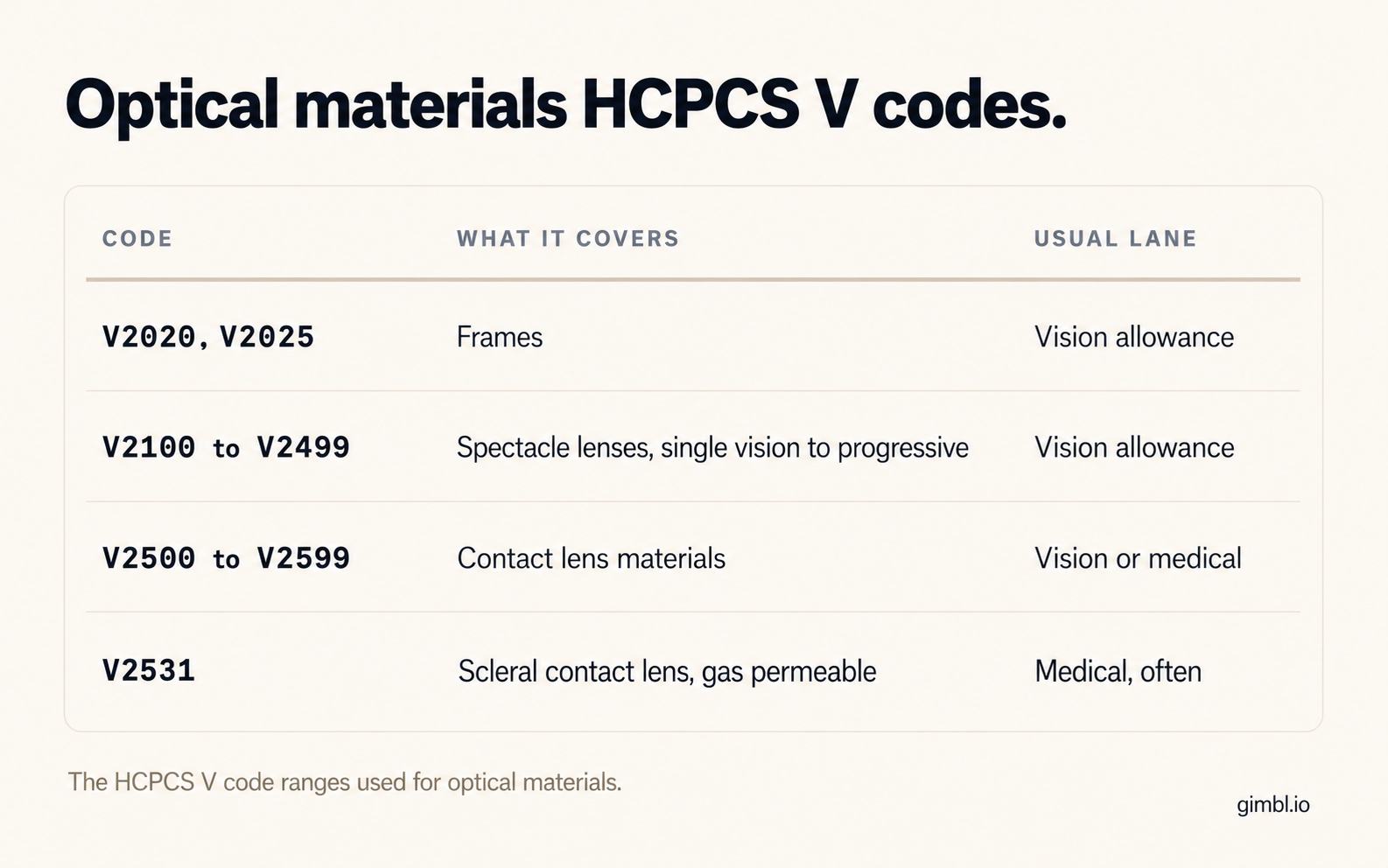
Once you move from the exam to the glasses and contacts, the codes shift from CPT to the HCPCS V code ranges. These are the optical billing codes that run against the member's materials allowance, with the balance billed to the patient.
Contact lens fitting
A standard contact lens fitting is 92310. A fitting for keratoconus is 92072, and a fitting for the treatment of ocular disease is 92071. The last two are condition driven, so they often belong on the medical claim rather than the vision materials benefit.
Key Takeaway
Optical materials use HCPCS V codes against the vision allowance. Fittings and materials tied to a condition, like keratoconus or scleral lenses, shift toward the medical claim.
The diagnosis codes that decide the payer
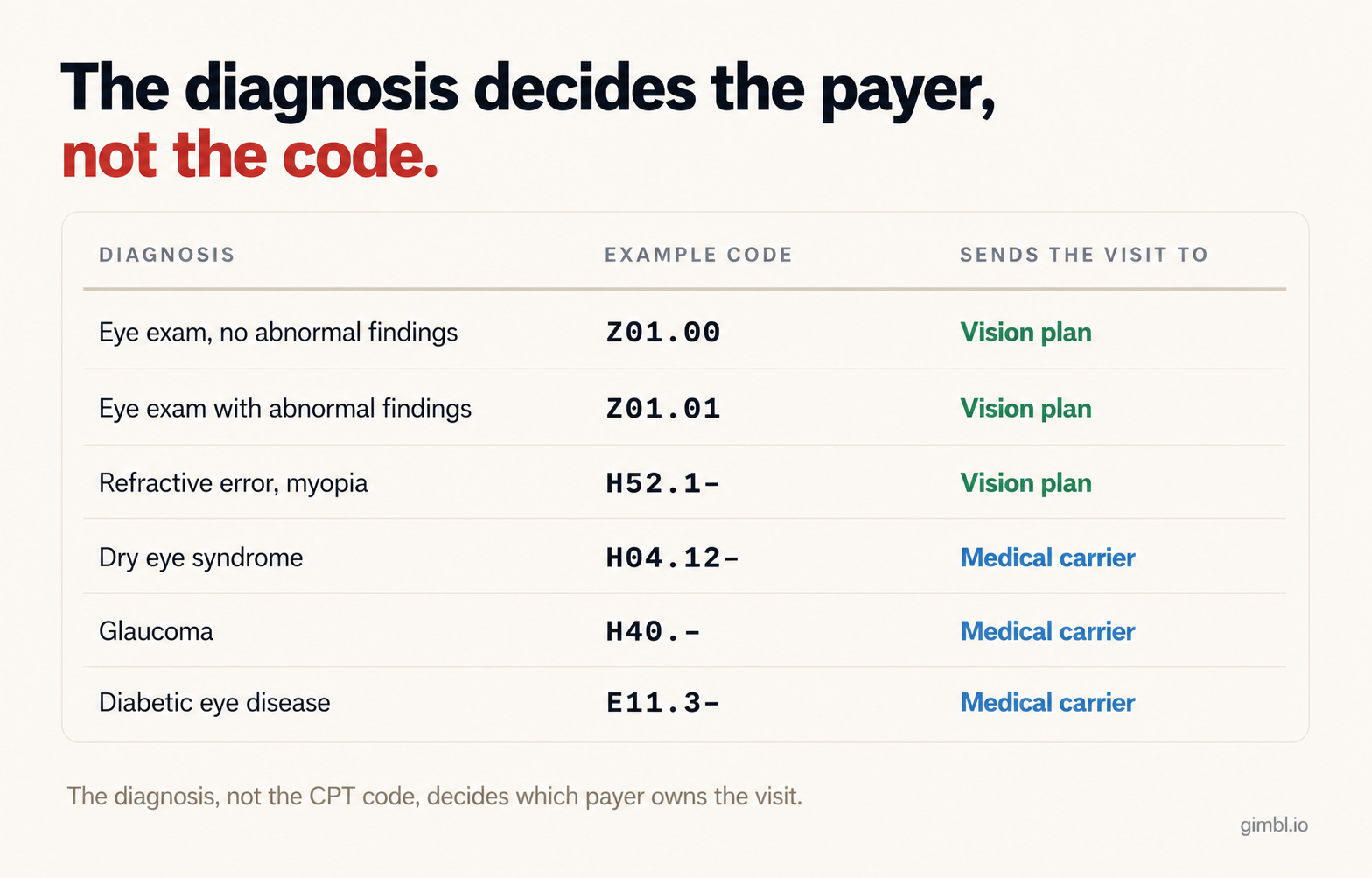
This is the part a plain code list leaves out, and it is the part that actually decides where the claim goes. The diagnosis is the switch. A routine diagnosis sends the visit to the vision plan. A medical diagnosis sends the same services to the medical carrier.
Routine exams are coded with the encounter codes for a general examination. The main ones are Z01.00, an encounter for examination of eyes and vision without abnormal findings, and Z01.01, the same encounter with abnormal findings. Refractive error codes from the H52 family, such as myopia, hyperopia, astigmatism, and presbyopia, describe what the refraction found and support the routine visit.
The moment the reason for the visit is a condition, the diagnosis changes and so does the payer. Dry eye, conjunctivitis, glaucoma, diabetic eye disease, and cataract each carry their own diagnosis code, and each moves the visit onto the medical claim.
Insight
Two visits can carry the identical exam code and go to two different payers. The only difference is the diagnosis, and that is chosen at check-in from the reason for the visit, long before the claim is built.
Key Takeaway
Pair every exam code with the right diagnosis. A routine code such as Z01.00 keeps the visit on the vision plan. A condition code moves the same services to medical.
Imaging and testing codes are condition driven
Diagnostic imaging and testing codes almost always route by why the test was done. Fundus photography is 92250, optical coherence tomography is 92133 for the optic nerve and 92134 for the retina, and a visual field is 92083. A screening image on a routine wellness visit can sit under the vision benefit, but the same image ordered to monitor glaucoma or diabetic retinopathy is a medical service and belongs on the medical claim.
Vision screening is its own small category. Visual acuity screening is 99173, and instrument based ocular screening is 99174 or 99177. These are screening codes, not the comprehensive exam, and are often used in pediatric or primary care settings rather than a full optometric exam.
Key Takeaway
Imaging and testing follow the reason they were ordered. Screening on a wellness visit can be vision. The same test to monitor a condition is medical.
Common vision coding mistakes that trigger denials
Most denials on these codes trace back to a mismatch, not a wrong number. Sending 92015 refraction to a medical carrier that never covers it. Pairing a routine exam code with a medical diagnosis, or a medical exam with a routine one. Billing a condition driven fitting like 92072 to the vision materials allowance. Coding an exam to the wrong patient status, new versus established. Running a diagnostic image under vision when it was ordered to monitor disease. Each one is a code that is correct on its own but wrong for the payer it was sent to.
Read More
For plan specific rules, see the VSP billing guide and the EyeMed billing guide. For the full picture, start with Vision Billing in Optometry and the pillar, Complete Guide to Optometry Billing.
Key Takeaway
Almost every denial here is a right code sent to the wrong payer. Match the exam code, the diagnosis, and the payer before the claim goes out, and the codes take care of themselves.
A vision billing code list is only half the answer, because the same code can be paid or denied depending on the diagnosis it is paired with and the payer it is sent to. The practices that get paid decide that pairing on purpose, at check-in, before the claim exists. See how GIMBL makes the medical versus vision call at intake, so the code and the payer always match.
Vision billing codes FAQ
What is the CPT code for a routine eye exam?
A routine eye exam is billed with the general ophthalmological codes: 92002 and 92004 for new patients, 92012 and 92014 for established patients. Some vision plans accept the routine exam codes S0620 and S0621 instead, which include the refraction. The comprehensive codes, 92004 and 92014, cover a full exam, while 92002 and 92012 cover an intermediate one. Choose the level the documentation supports.
What ICD-10 code is used for a routine eye exam?
The main diagnosis codes for a routine eye exam are Z01.00, an encounter for examination of eyes and vision without abnormal findings, and Z01.01, the same encounter with abnormal findings. Refractive error codes from the H52 family, such as myopia, hyperopia, astigmatism, and presbyopia, are added to describe what the refraction found. These routine codes keep the visit on the vision plan.
Does vision insurance cover refraction, CPT 92015?
Yes, refraction is generally covered under a routine vision benefit, which is why it belongs on the vision claim. CPT 92015 is a separately billable service that Medicare and most medical carriers do not cover, so it is never sent to the medical side. When a plan uses the bundled S0620 or S0621 exam codes, the refraction is already included and is not billed separately.
Why does the same exam code sometimes bill to medical?
Because the diagnosis, not the CPT code, decides the payer. A comprehensive exam coded to a routine diagnosis like Z01.00 bills to the vision plan. The same exam coded to a medical condition such as dry eye or glaucoma bills to the medical carrier. The code describes the service, but the diagnosis and the reason for the visit determine which insurance owns it.
Are VSP and EyeMed billing codes different?
No, VSP and EyeMed run on the same CPT and HCPCS codes as the rest of eye care. What varies is the plan design, the allowances, and whether a plan prefers the 92000 series with a separate 92015 or the bundled S0620 and S0621 exam codes. The codes are standard. The plan rules around them differ, so confirm each member's benefit before the visit.