
In optometry, coordination of benefits is not billing the same visit twice. It is one visit that belongs to two payers, and knowing how to split it.
Ask ten independent optometry practices how they handle a patient carrying both a medical plan and a vision plan and you will get ten different answers. Most pick one plan, file one claim, and move on. A few bill both and get a takeback months later. Very few do it the way it is meant to work.
Coordination of benefits, usually shortened to COB, is the rulebook for what happens when a patient is covered by more than one plan. It is a standard concept across healthcare. Eye care has a structural wrinkle no other specialty has, and getting that wrinkle wrong costs money in both directions.
Key insight:
In most of healthcare, coordination decides an order. In eye care it usually decides a division, and that is a different question with a different answer.
What coordination of benefits actually means
Coordination of benefits is the process insurers use to decide who pays first when a patient holds more than one plan. It exists so the combined payment never exceeds the cost of the care. One plan is primary and pays first. If anything remains, a secondary plan may pick up part of it. Neither the patient nor the provider collects twice.
That framework was built for a specific situation, which is two plans that both cover the same service. A patient with their own employer plan and a spouse's plan. A Medicare beneficiary who also holds retiree coverage. Both plans could pay the office visit, so the rules decide the order. The general mechanics are documented by the Centers for Medicare and Medicaid Services and by every major carrier.
Nothing in that description is unique to eye care, which is exactly the problem.
Key insight:
The standard COB framework assumes two plans competing to pay for the same thing. In eye care the two plans usually are not competing at all.
Why Coordination Works Differently in Optometry
A vision plan and a medical plan are built for different jobs.
A vision plan is a wellness and materials benefit. It covers the routine exam, the refraction, and glasses or contact lenses. A medical plan covers the eye as a medical organ, so symptoms, injury and disease. If the split between them is not already clear, the difference between medical and vision insurance is where to start, because coordination sits directly on top of that decision.
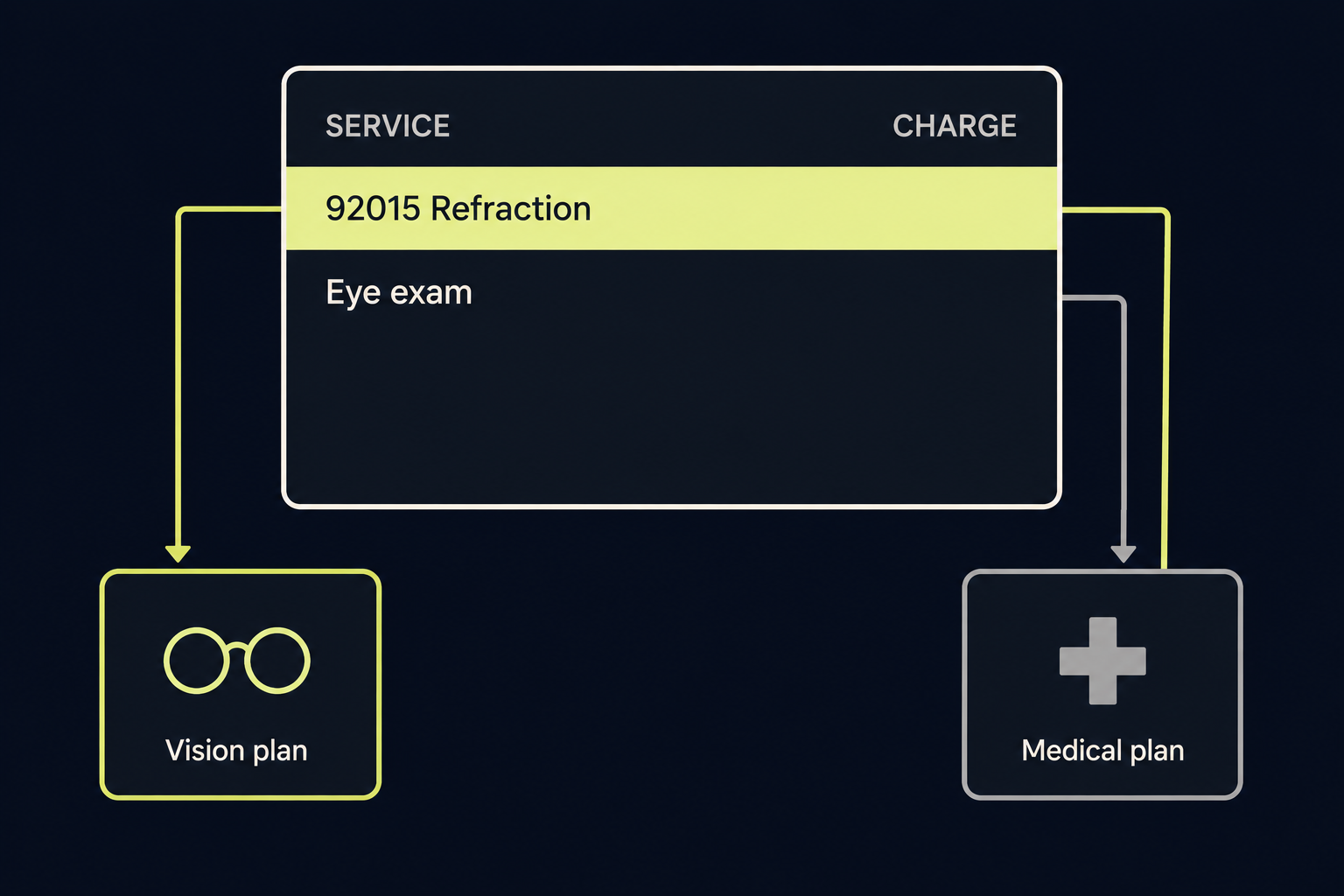
Because the two plans cover different services, they are rarely primary and secondary to each other. When a single visit contains both a medical service and a routine service, each piece goes to the payer that owns it. The medical work bills to the medical carrier. The refraction or routine materials bill to the vision plan. Two claims, two payers, one visit, each claim honest about what it covers.
Vision plans generally reflect this in their own documents. Davis Vision's provider manual states that Davis Vision does not, in general, coordinate benefits with other insurance companies for in-network services, that there are a few exceptions and the practice should call member services in those cases, and that for out-of-network claims where the patient has already gone to their primary carrier, the primary carrier's explanation of benefits should be attached to the claim. [VERIFY: confirm against the current Versant Health provider manual before publishing. This is quoted from the April 2016 Davis Vision provider manual.]
Key insight:
Two plans that cover different services cannot be sequenced against each other, which is why treating a vision plan as secondary on a medical claim produces denials that read as nonsense.
Billing medical and vision insurance for the same visit
The clearest example is a patient who has dry eye disease and also wants a refraction for new glasses. Both happen in the same chair on the same day.
Handled correctly, the medical exam and the dry eye work bill to the medical carrier with the medical diagnosis. The refraction bills separately to the vision plan under CPT 92015, because refraction is a vision benefit rather than a medical one. Most medical payors, Medicare among them, treat 92015 as non covered on the grounds that it is not medically necessary. The refraction billing guide covers why that code does not belong on a medical claim, and the vision billing codes reference covers the rest of the set.
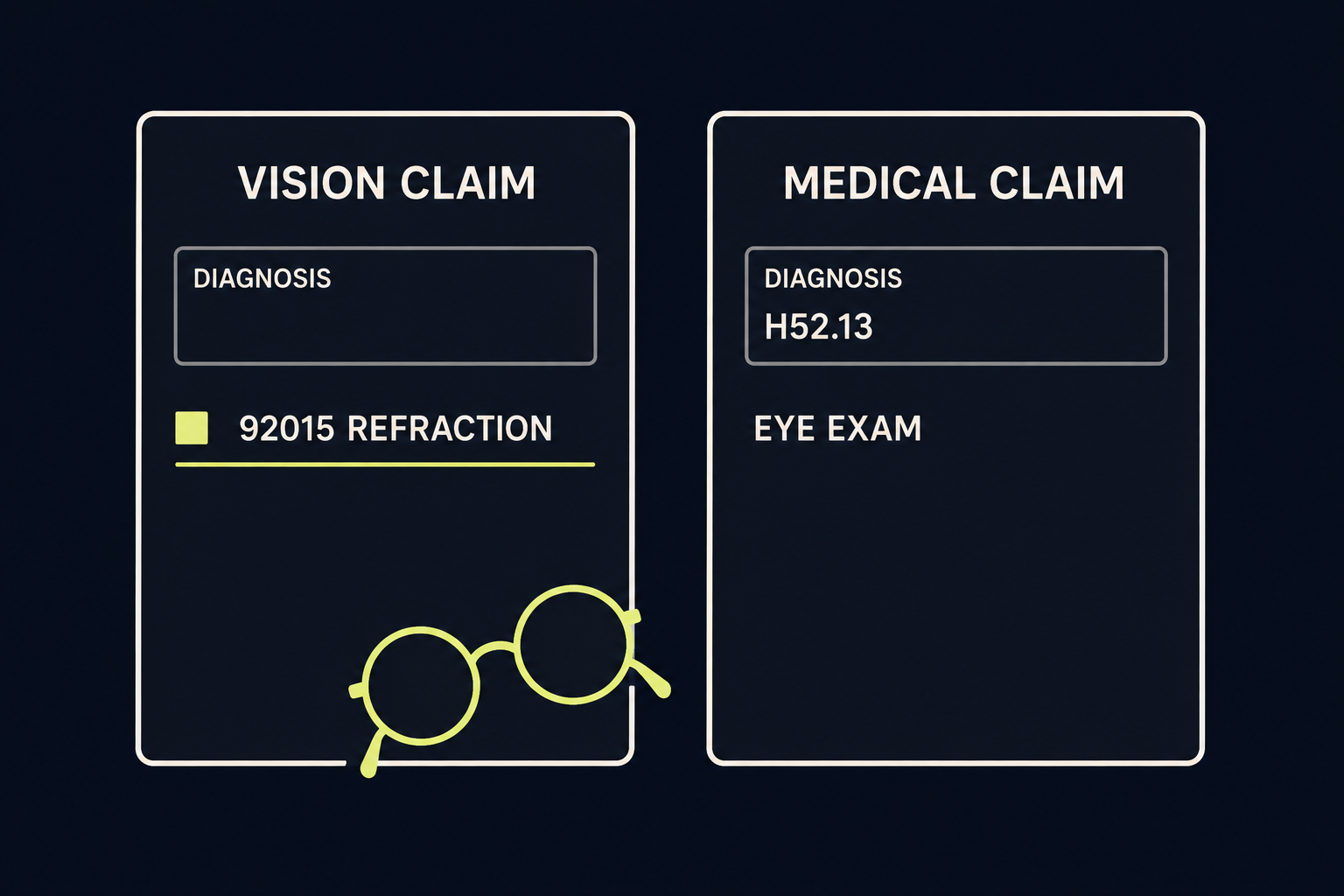
Two distinct services, separately documented, each on its own claim. That is what coordination looks like in practice.
The reason for the visit decides which plan owns which part of it. A patient who came in because something is wrong with the eye had a medical visit that also included a refraction. A patient who came in for glasses and happened to mention dryness did not.
Key insight:
The split follows the reason for the visit, not the card the patient handed over, and the reason exists before any code does.
Coordination of Benefits and the Line You Cannot Cross
Coordinating two distinct services across two payers is legitimate. Sending the same single service to both plans is not.
Billing the same exam to the medical carrier and to the vision plan in the hope of collecting twice is a false claim. Federal False Claims Act penalties are assessed per claim, they are adjusted for inflation by the Department of Justice every year, and they run to tens of thousands of dollars per claim before any repayment or exclusion is considered.
The rule is short enough to put on a wall. Coordinate distinct services across two payers. Never the same service twice. When it is unclear whether two services are genuinely distinct, bill one and let the patient self pay the other.
Key insight:
The test is not whether two plans exist. It is whether two separately documented services exist.
Coordination of Benefits With Two Medical Plans
The classic version of coordination does appear in eye care, just less often.
When a patient carries two medical plans that both cover a medical eye visit, the usual primary and secondary rules apply. The primary plan is billed first, its explanation of benefits comes back, and only then is the secondary plan billed for the remainder.
A few standard rules decide the order. A patient's own employer plan is generally primary over a plan they are covered under as a dependent. For a child covered by both parents, the birthday rule applies, meaning the plan of the parent whose birthday falls earlier in the calendar year pays first. Medicare has its own secondary payer rules that determine when it pays first and when it pays after a group health plan.
These are the situations most people picture when they hear coordination of benefits. They are worth knowing and they are the minority of eye care encounters.
Key insight:
Primary and secondary rules apply when two plans could pay for the same service. Applying them between a vision plan and a medical plan is where most coordination denials in eye care start.
Where Coordination of Benefits Goes Wrong in Optometry
Four failures account for most of it.
The first is absorbing a medical service under the vision benefit, so the medical carrier is never billed and the medical work is paid at a routine rate or not at all.
The second is the reverse, pushing a routine refraction onto a medical claim, where it denies as non covered.
The third is missing the dual coverage entirely, because the front desk entered one plan and nothing ever flagged that the patient held both.
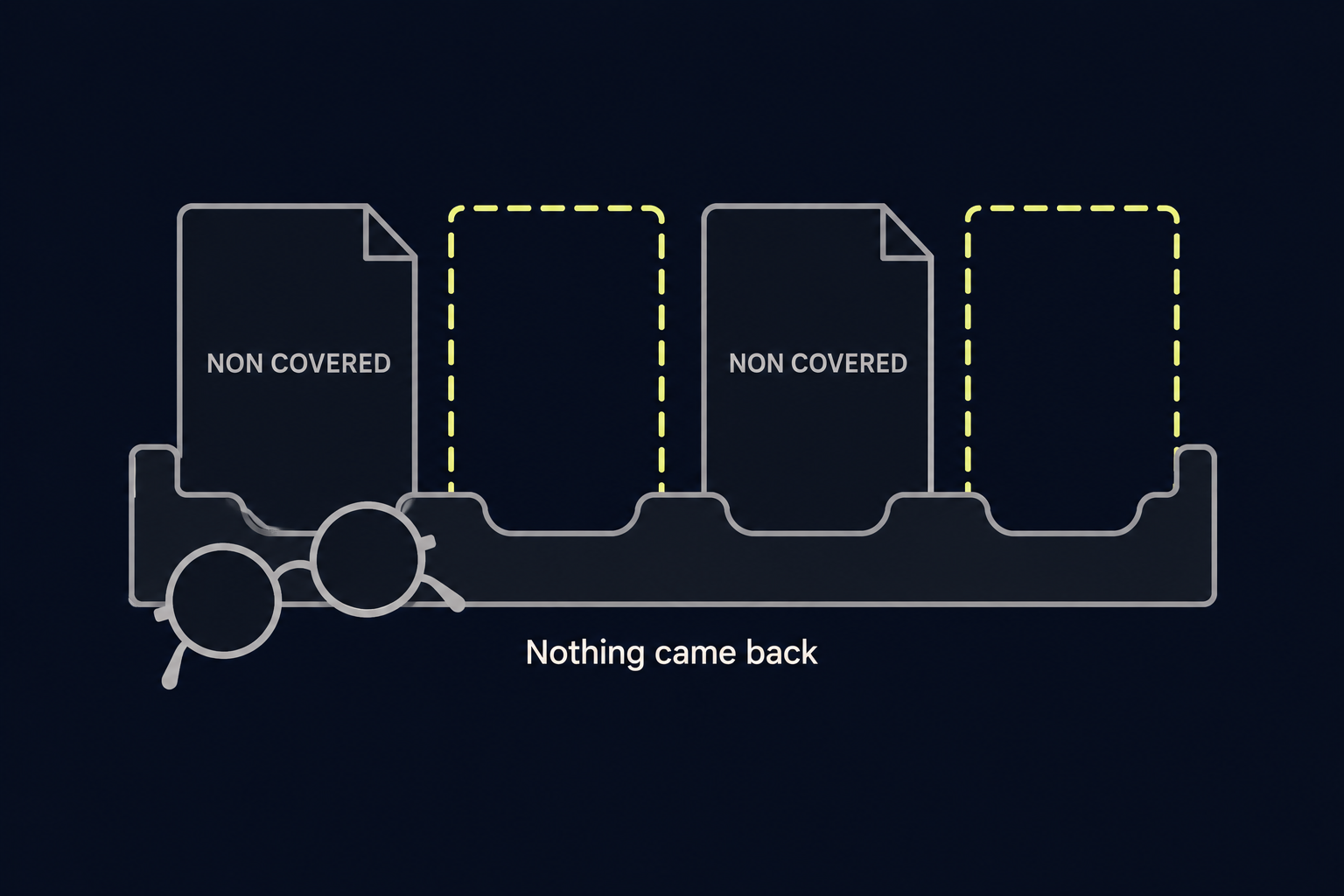
The fourth is the compliance error above, billing one service to both plans.
Only two of those four produce a denial anyone sees. The other two close quietly, either paying at the wrong rate or never generating a second claim at all, which is what makes coordination easy to miss and expensive over a year.
The timing makes it worse. A claim that goes to the wrong plan first is not simply delayed, because the filing window on the plan that should have received it counts from the date of service rather than from the denial. Davis Vision allows sixty days from the date services were provided, and that window has been running the entire time the claim sat in a work queue.
Key insight:
The two failures that cost most are the two that never produce a denial, which is why coordination losses do not show up in a denial report.
How to get coordination of benefits right at check-in
Coordination is not really a billing task, even though that is where the cleanup lands. It is decided at intake, before a claim exists. By the time the encounter reaches billing the payer is chosen and the diagnosis is attached, and no amount of downstream skill undoes a coordination that was never set up.
Three habits at the front desk cover most of it.
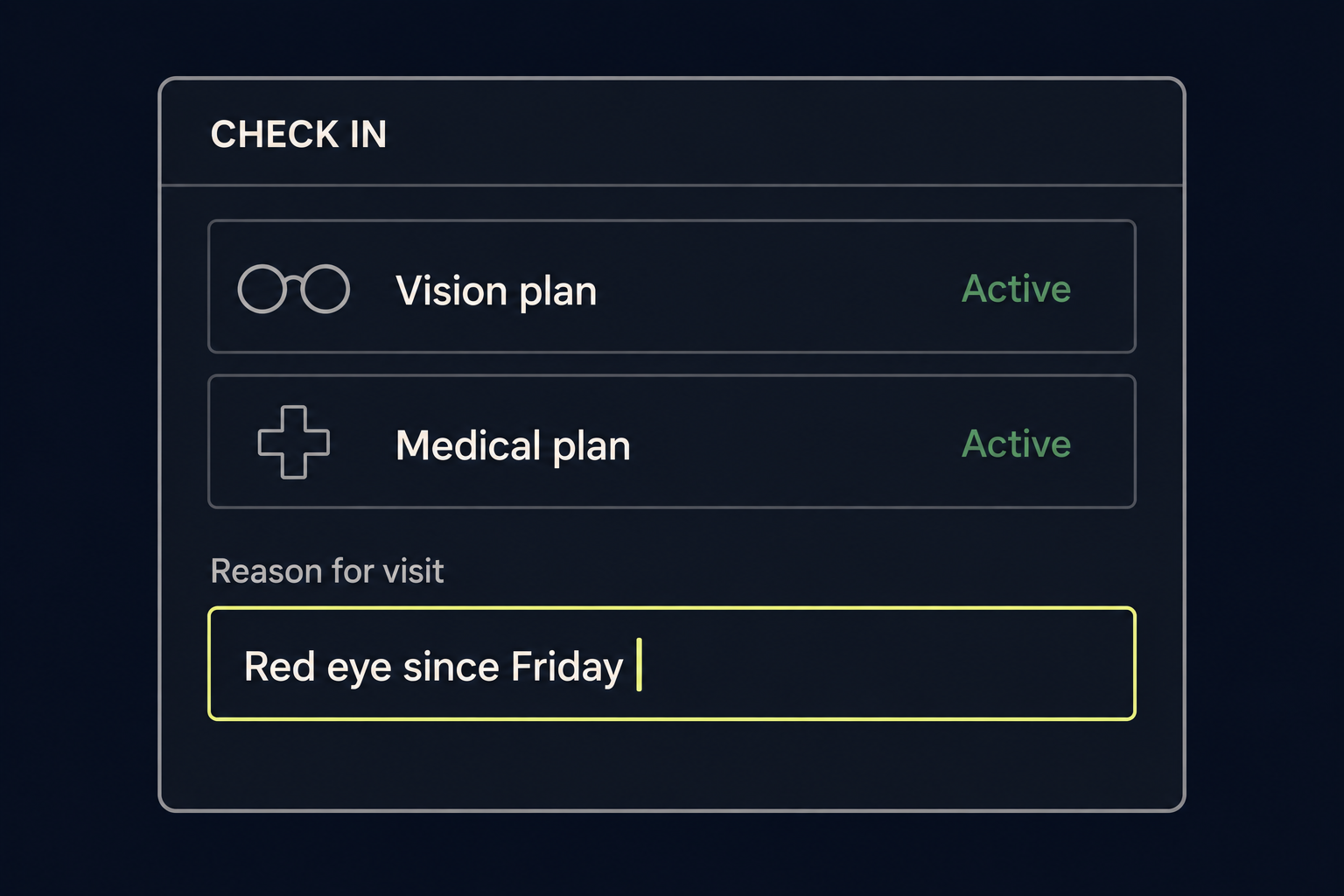
Capture every plan the patient holds rather than the first card handed over. Flag dual coverage on the encounter so whoever builds the claim knows a split may apply. And confirm the reason for the visit before selecting a payer, so the medical piece and the routine piece are identified while the patient is still standing there.
None of that needs new staff or new software. It needs the dual coverage to be visible at the moment the decision is made, which is the only moment it can be acted on. Plan-specific rules vary from there, and the VSP billing guide covers one of the two largest.
Key insight:
Every coordination decision is made before a claim exists, so every fix has to be made there too.
The next step: catch the dual coverage before the claim
The split is decided at check in, by whoever sees the cards and hears the reason for the visit.
Sources
Centers for Medicare and Medicaid Services, coordination of benefits and recovery. Davis Vision provider manual, coordination of benefits section. Optometric Management, September 2025, on CPT 92015 coverage by medical payors. Department of Justice civil monetary penalty inflation adjustments, published annually in the Federal Register.
Frequently asked questions
What does coordination of benefits mean in optometry?
Coordination of benefits is how insurers decide who pays when a patient holds more than one plan. In optometry it usually means splitting a single visit between a vision plan and a medical plan, because the two cover different services, rather than deciding a primary and secondary order.
Can you bill medical and vision insurance for the same visit?
Yes, when the visit contains two distinct, separately documented services. The medical exam bills to the medical carrier and the routine refraction bills to the vision plan, as two separate claims. Billing both plans for the same single service is a false claim and is not permitted.
Which insurance is primary, medical or vision?
Neither, in most eye care visits. A medical plan and a vision plan are not primary and secondary to each other because they cover different services. Primary and secondary rules apply only when a patient holds two plans that both cover the same service, such as two medical plans.
What is the birthday rule in coordination of benefits?
When a child is covered by both parents' medical plans, the birthday rule makes the plan of the parent whose birthday falls earlier in the calendar year the primary payer. It applies only to two plans covering the same person for the same service, not to a medical plan and a vision plan.
Do vision plans coordinate benefits with medical plans?
Generally not, because they cover different services. Vision plan manuals commonly state that the plan does not coordinate benefits with other carriers for in-network services, with limited exceptions. The practical result is that a claim sent to the wrong plan comes back rather than being passed along.
Which plan pays for the refraction?
The vision plan. CPT 92015 is a vision benefit, and most medical payors, including Medicare, treat it as non covered because it is not considered medically necessary. It stays on the vision claim even when the rest of the visit is medical.
What happens if the claim goes to the wrong plan first?
It usually returns as non covered, which reads like a benefit outcome rather than an error. The rebill then runs against a filing window that started on the date of service, so it is more urgent and less appealable than it looks.