
There is no single CPT code for an eye exam, and the reason practices lose money here is not that they cannot tell 92004 from 92014. It is that the code is chosen from what happened in the room, when it is actually decided by who owns the visit.
The CPT codes for eye exams come in two families. Four ophthalmological visit codes cover the exam itself. A second family, the office visit E/M codes, can describe the identical thirty minutes. Both are correct. Only one of them is correct for this patient, on this plan, today.
Key insight:
The exam does not pick the code. The payer does, and the payer was decided at check in by whoever asked why the patient came in.
What the CPT code for an eye exam actually is
Two families, and everything else on this page follows from which one you are in.
The ophthalmological visit codes, 92002 through 92014, were written for eye care. They are defined by the scope of the visual system evaluation and by whether the patient is new or established. Their full CPT definition includes a clause most guides drop, and that clause is where the denials come from.
The evaluation and management codes, 99202 through 99215, are the general office visit codes every specialty uses. Since 2021 they are selected on medical decision making or total time, not on history and exam bullets.
Optometry is one of the few specialties with genuine access to both. That is an advantage and it is also the trap, because two valid answers to the same question is how a practice ends up choosing on habit.
Key insight:
Both families can describe the same exam honestly. Habit is not a selection criterion, and it is the one most practices are actually using.
Eye visit codes vs E/M codes: 92014 vs 99213 is not a style choice
The comparison everyone searches, and almost every answer describes the difference without stating the consequence.
Here is the consequence. Eye visit codes carry frequency edits. E/M codes do not. The American Academy of Ophthalmology puts it plainly: "Some payers have frequency edits, or limits on how often you can bill eye visit codes in a year," and separately, "Payers do not have frequency edits for E/M codes."
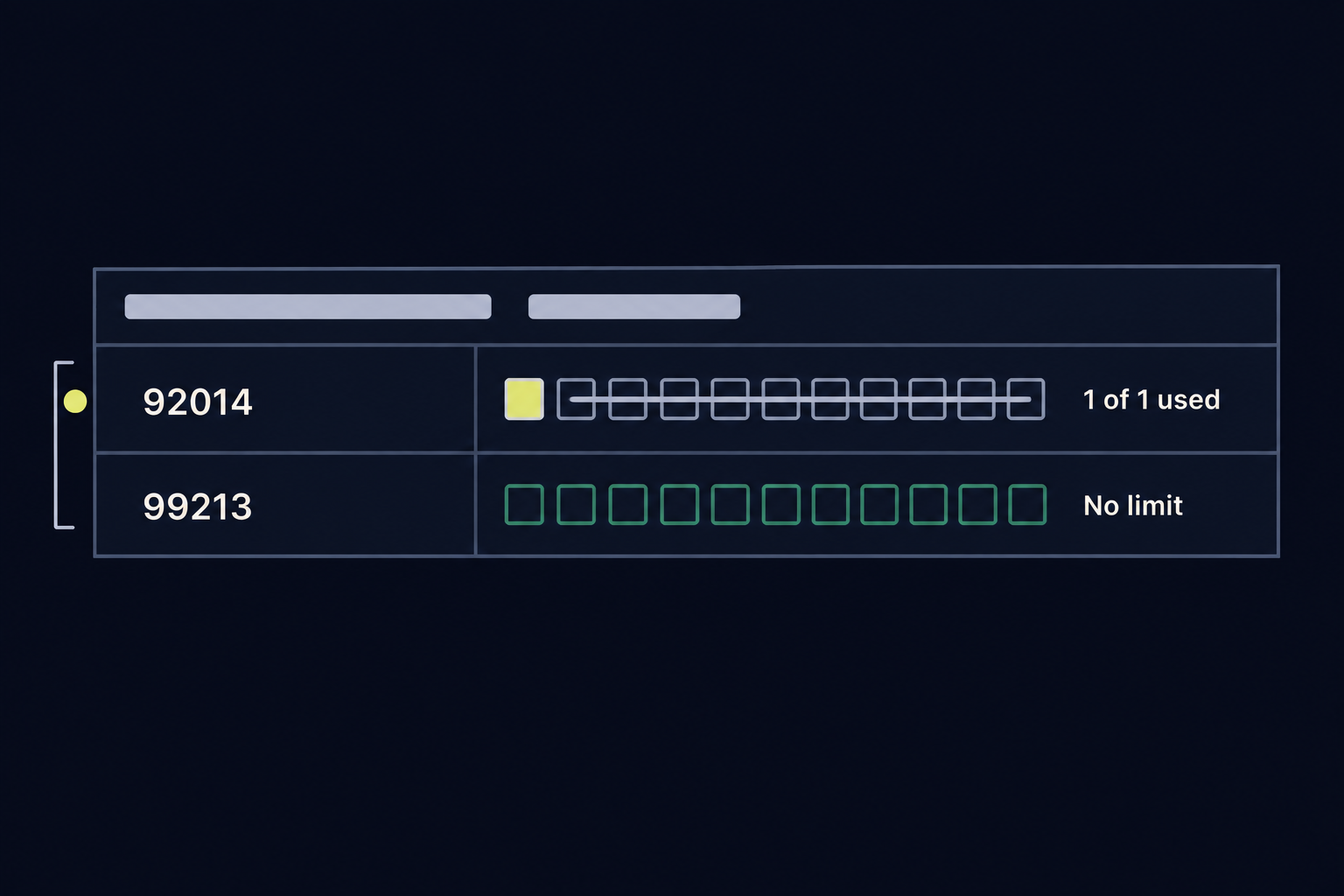
That asymmetry is not an accident of policy. Payers associate the 92000 series with routine care because that is what it was built for, and routine care is capped by design. They associate E/M with medical care, and medical care is capped by medical necessity instead.
So the choice between 92014 and 99213 is not a documentation preference. It is the routing decision showing up again, three steps downstream, wearing a code number.
One rule that is not optional: you may not report an eye visit code and an E/M service for the same encounter. Both describe the evaluation of the patient. Billing both is billing the same work twice.
Key insight:
A practice that bills 92014 by default on medical visits is spending a capped benefit on work the medical plan would have paid without a cap.
92004 CPT code and 92014 CPT code: the comprehensive pair
92004 is the comprehensive service for a new patient. 92014 is the comprehensive service for an established one. The clinical work is the same; only the relationship changes.
The full CPT definition of 92004 is "medical examination and evaluation with initiation of diagnostic and treatment program; comprehensive, new patient, one or more visits." For 92014 it is the same with "initiation or continuation."
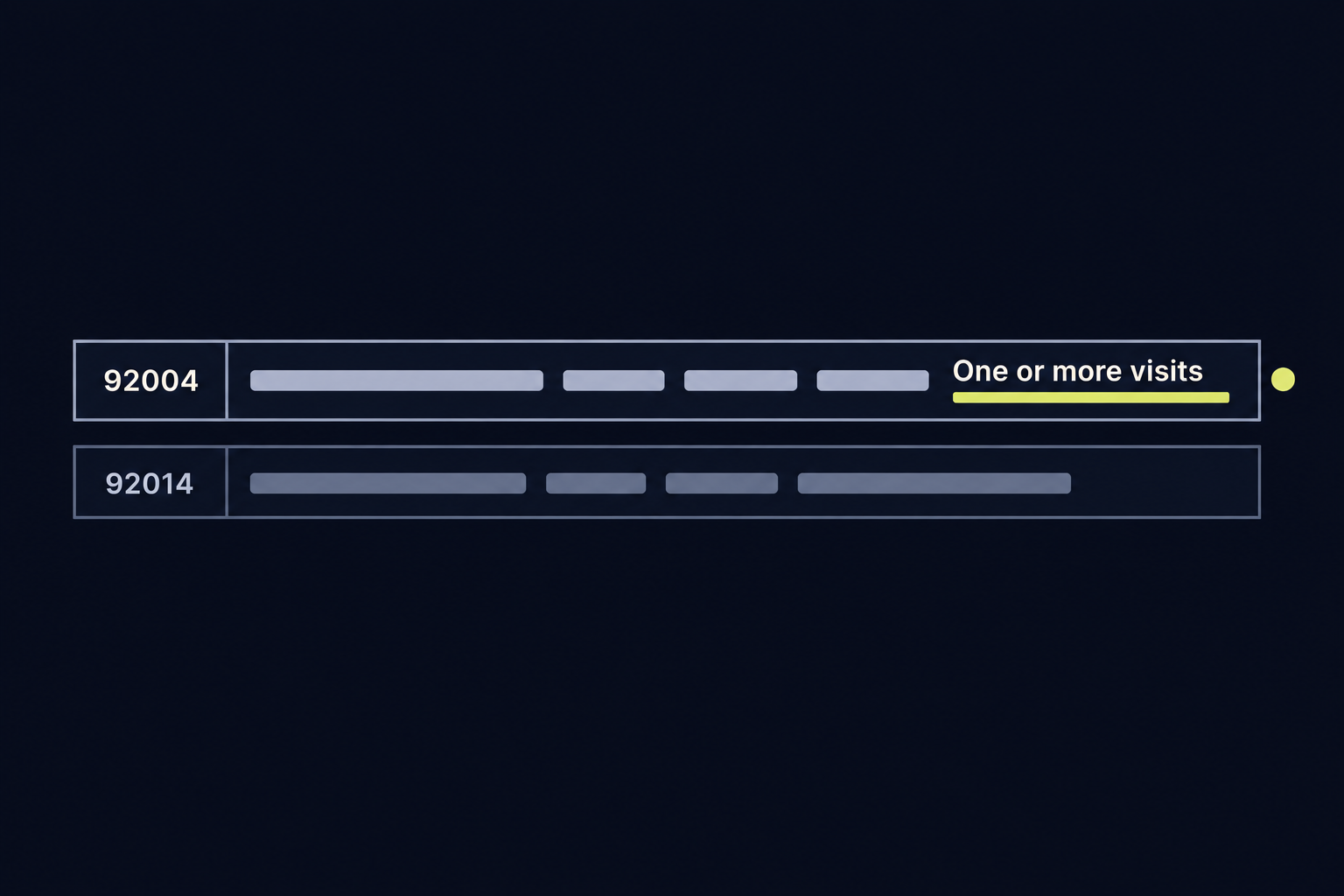
Two things are hiding in that sentence.
"One or more visits." A comprehensive eye exam does not have to be completed in a single sitting. If the patient ran out of patience, or the dilation was deferred, or the room ran late, the service can be finished at the next visit and still be reported as comprehensive. Practices routinely drop to an intermediate code because the day fell apart, when the code they were entitled to explicitly allows a second visit.
"Initiation of diagnostic and treatment program." This is not preamble. It is a required element of the code, and it is the single most common reason a comprehensive claim comes back as an intermediate one.
Key insight:
"One or more visits" is in the code definition. An exam interrupted is not automatically an exam downgraded.
92012 CPT code and 92002: what intermediate actually means
The intermediate codes are not "a shorter comprehensive." CPT describes them as the evaluation of a new or existing condition complicated by a new diagnostic or management problem. That is a different clinical situation, not a lesser version of the same one.
92002 is intermediate, new patient. 92012 is intermediate, established.
| Code | Level | Patient | What it describes |
|---|---|---|---|
| 92002 | Intermediate | New | A new or existing condition complicated by a new diagnostic or management problem |
| 92012 | Intermediate | Established | The same, for a patient already in the practice |
| 92004 | Comprehensive | New | General evaluation of the complete visual system, one or more visits |
| 92014 | Comprehensive | Established | The same, for a patient already in the practice |
A glaucoma pressure check with a medication adjustment is an intermediate service. A full visual system evaluation that happened to finish early is not.
Key insight:
Intermediate is a description of the encounter, not a consolation prize for a comprehensive exam that fell short.
The downcode trigger: initiation of diagnostic and treatment program
If one section of this page is worth reading twice, it is this one.
Both comprehensive codes require the initiation, or for an established patient the continuation, of a diagnostic and treatment program. The Academy is explicit that payers "may downcode from 92004/92014 to 92002/92012 if documentation lacks initiation of diagnostic and treatment program."
The Academy's fact sheet lists what satisfies it. At least one of:
• prescribing medication, glasses or contact lenses
• arranging special ophthalmological diagnostic or treatment services
• consultations
• laboratory procedures
• radiological services
• the recommendation, decision, scheduling or performance of a major or minor surgical procedure
• scheduling necessary follow up
Read that list again, because most comprehensive exams satisfy it in the first thirty seconds and never say so in the chart. "Return in twelve months" is scheduling necessary follow up. A glasses prescription is prescribing. An OCT ordered for next week is arranging a special diagnostic service.
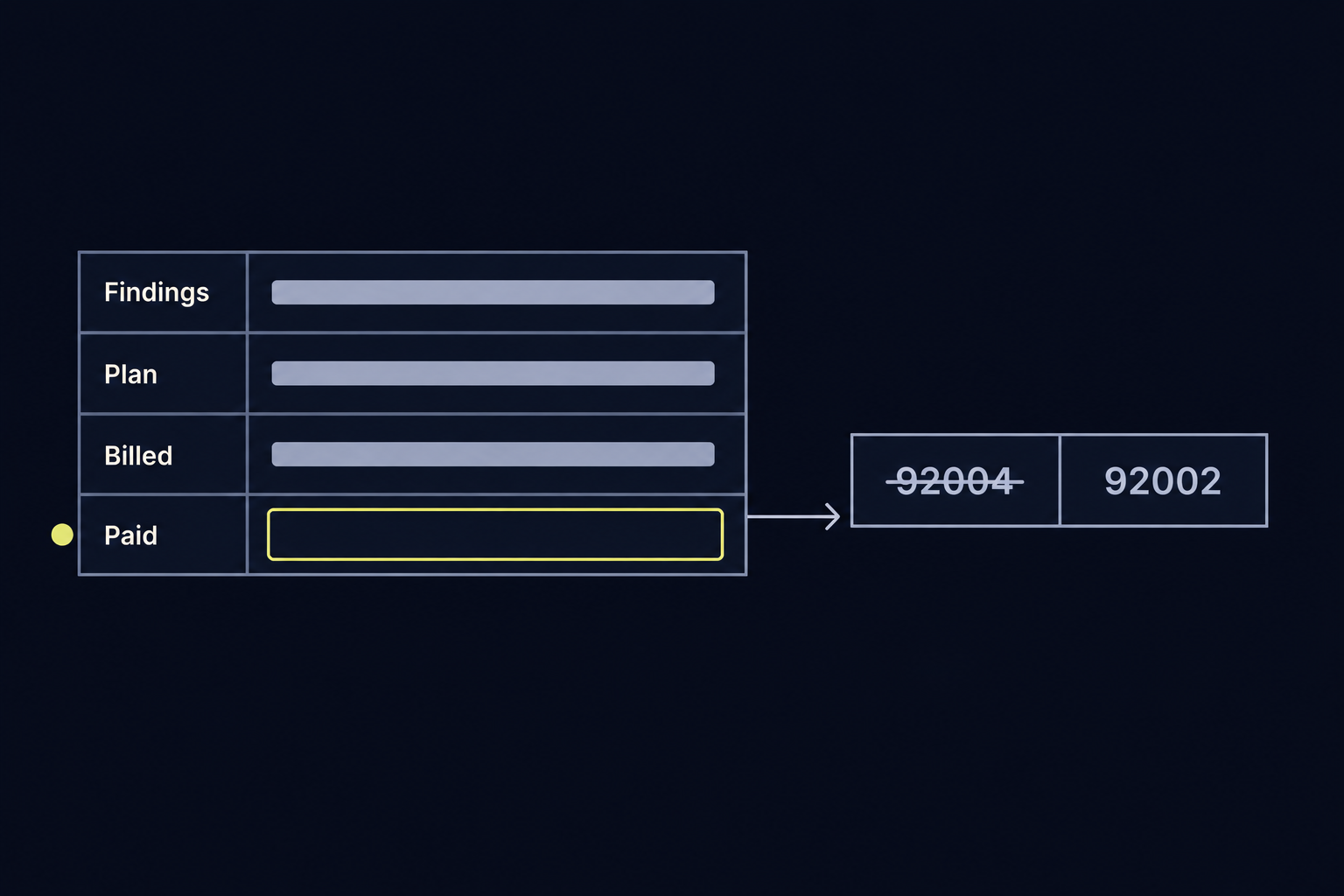
The exam was comprehensive. The documentation forgot to say what happens next, so the payer read it as an evaluation with no plan, and paid for one.
Key insight:
The downcode is almost never about what the doctor examined. It is about a plan that existed in the room and never reached the chart.
Eight of eleven: the element count Medicare actually uses
CPT describes the comprehensive service in prose. Medicare's local coverage policy turns it into arithmetic, and this is the line practices can audit themselves against.
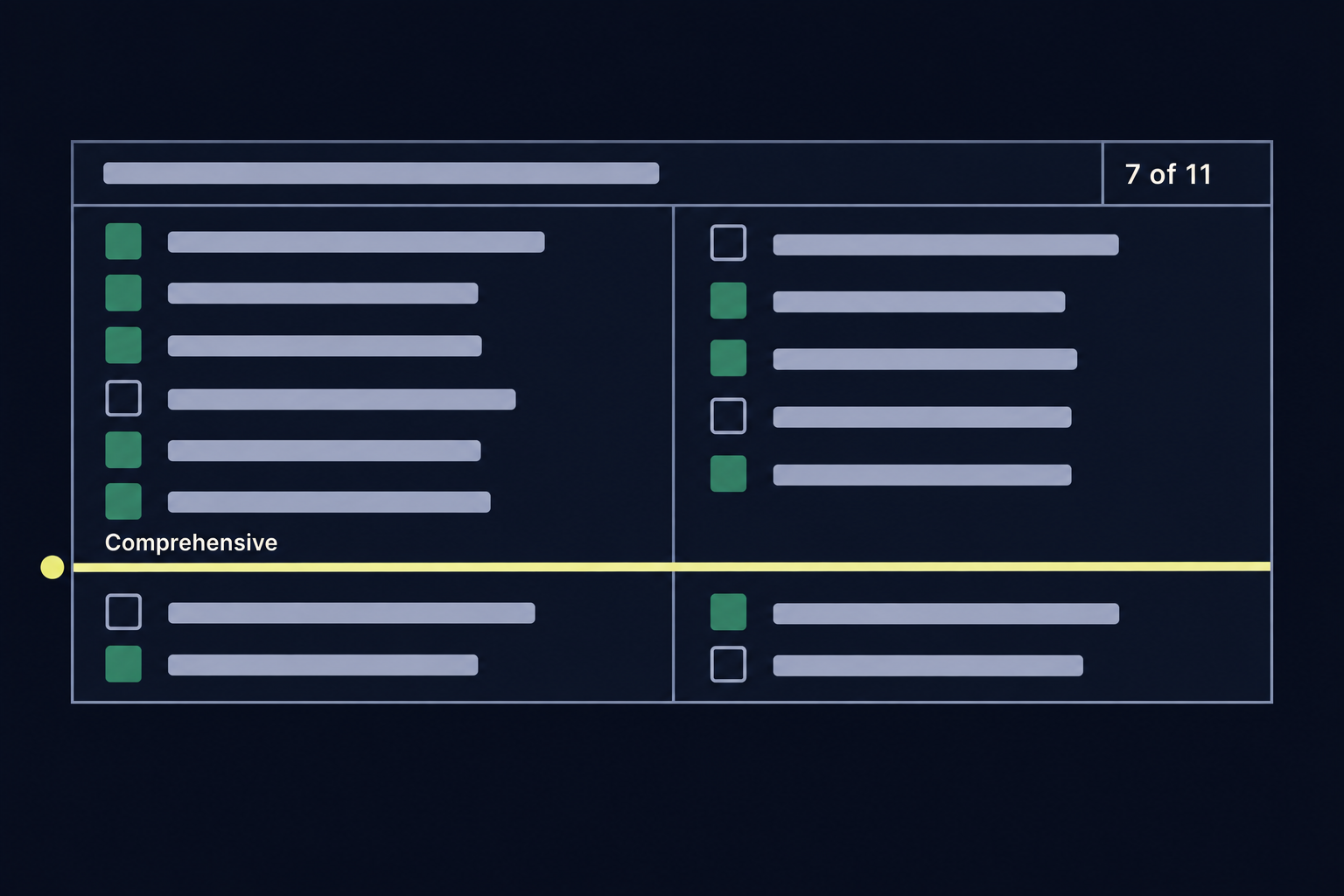
Eight or more of eleven physician examination elements supports a comprehensive service. Seven or fewer is intermediate.
The eleven: confrontation visual fields, eyelids and adnexa, ocular mobility, pupils and iris, cornea, anterior chamber, lens, intraocular pressure, retina, optic disc, and visual acuity.
On dilation, the Academy is specific. Dilation is not mandatory, but "if dilation is not performed, documentation must clearly state why." Dilation is not a requirement for E/M codes at all, which is one more line in the 92014 versus 99213 column.
Key insight:
Count the elements in the chart before the claim goes out. Eight is a number a biller can check in ten seconds and a payer will check for you in forty five days.
New or established, and the thirty six month rule
Wrong patient status is a quiet, repeatable error, because nothing about it looks wrong on the claim.
A new patient is one who has not received a professional service from you, or from another provider of the same specialty in the same group practice, within the past thirty six months. Not "new to this doctor." Not "we have not seen them in a while."
The failure runs in both directions. A patient last seen four years ago checked in as established gets 92014 when 92004 was payable, which is money left behind. A patient seen last year by your associate and checked in as new gets 92004, which is an overpayment and an audit pattern if it repeats.
Key insight:
Status is a question about the practice and the specialty, not about the doctor. A patient your associate saw eighteen months ago is established for you.
Refraction sits beside the exam code, never inside it
92015 is the determination of refractive state. It is billed in addition to the exam code, never instead of it, and it is never part of a global surgical package.
Medicare treats refraction as a statutory non covered service, which means the charge belongs to the vision plan or to the patient. Because the exclusion is statutory rather than a medical necessity denial, no Advance Beneficiary Notice is required.
That is the whole of it here, because the code has a page of its own. How to bill 92015 without a denial covers the two lanes the charge can travel and the patient conversation that goes with it.
Key insight:
Refraction is a separate service on the same claim. Folding it into the exam does not simplify the visit, it donates it.
Which payer owns the visit, and why the CPT code for the eye exam follows
Everything above assumes a decision that was made before any of it: which plan this visit belongs to.
A routine check with no complaint belongs to the vision plan, and it is billed with an eye visit code or a vision plan exam code, plus the refraction. A visit driven by a symptom, an injury or a diagnosed condition belongs to the medical carrier, and it is billed with an eye visit code or an E/M code carrying a medical diagnosis. The line between them is set out in full in medical vs vision insurance, and when both plans have a part to play the order they are asked in is its own decision, covered in coordination of benefits in optometry.
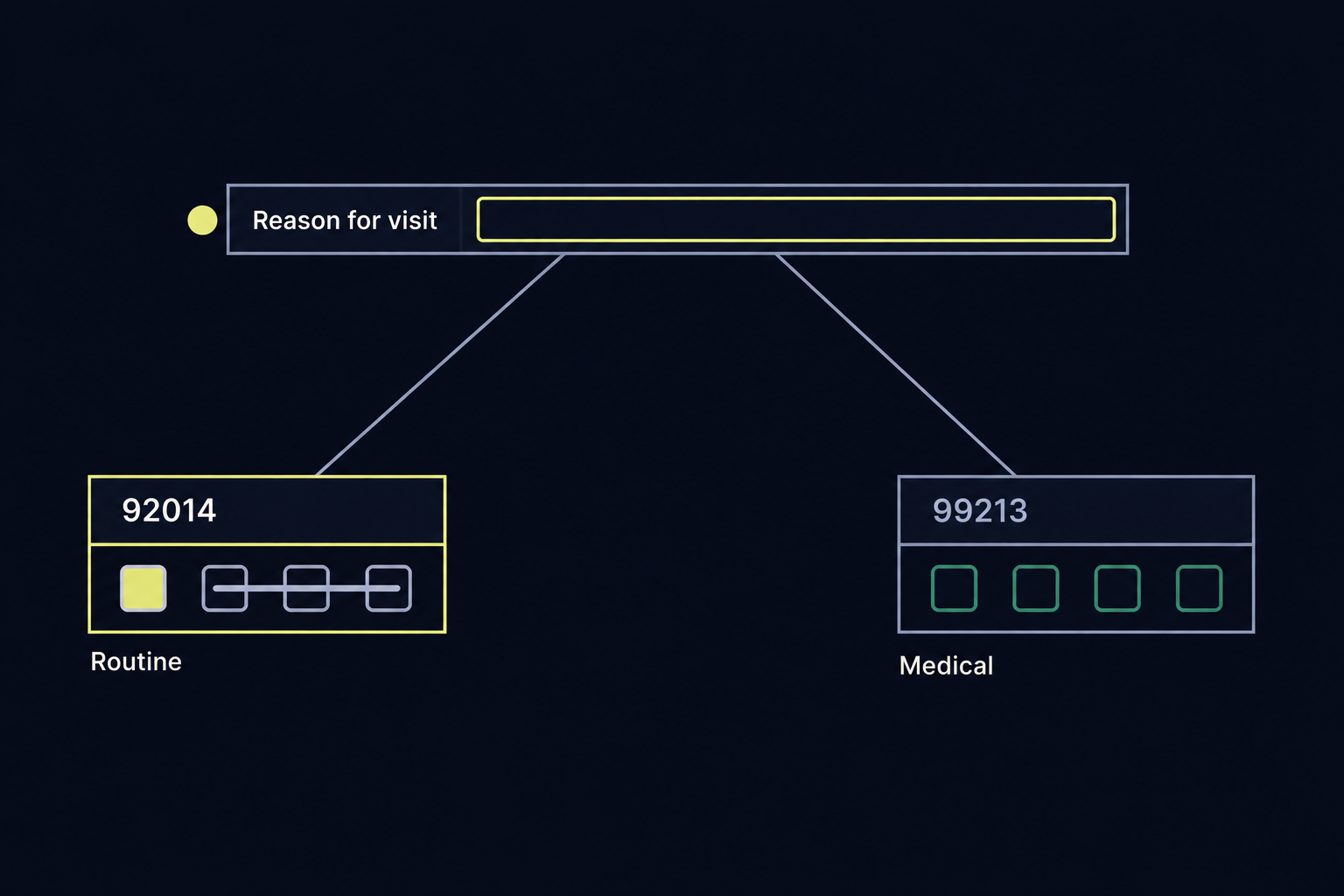
Get that call wrong and what happens next is worse than a denial. The code is valid. The diagnosis is valid. The patient is eligible. The claim pays, at the routine rate, and nothing on the remittance says wrong payer. No scrubber flags it, because there is nothing malformed to flag.
The frequency edits make it compound. A medical visit sent to the vision plan does not only underpay, it spends a once a year benefit the patient may need in March. How each of the large plans handles the exam and the frequency counter is in the VSP billing guide.
Key insight:
A misrouted eye exam is a perfectly formed claim. That is exactly why every tool downstream of it lets it through.
Diagnosis codes, and matching the story the CPT codes for eye exams tell
The CPT code says what was done. The diagnosis says why, and the two have to tell the same story.
A routine encounter is usually Z01.00, examination of eyes and vision without abnormal findings, or Z01.01, with abnormal findings. Refractive error sits in the H52 family. A medical encounter carries the condition itself, coded to the highest specificity the record supports.
A routine Z code on a medical eye code, or a medical diagnosis on a routine vision claim, is a mismatch a payer notices. The wider code and diagnosis reference, including the vision plan exam codes and the materials V codes, is in the vision billing codes guide.
Key insight:
The diagnosis does not choose the payer. It has to agree with the payer the reason for the visit already chose.
Next step: decide the payer before the code
GIMBL checks eligibility on both the vision plan and the medical plan at intake, decides which one the visit belongs to, and builds the claim before the exam. Everything downstream of that moment, from charge entry through to denial follow up, sits in the optometry billing guide.
Start here: gimbl.io/auth/register
Frequently asked questions about the CPT code for an eye exam
What is the CPT code for a routine eye exam?
There is no single code. A routine exam is usually billed with an ophthalmological visit code, 92002, 92004, 92012 or 92014, plus 92015 for the refraction, or with a vision plan exam code where the plan requires one. Which one depends on the plan and on whether the patient is new or established.
What is the difference between 92014 and 99213?
92014 is the comprehensive ophthalmological visit code for an established patient, selected on the scope of the visual system evaluation. 99213 is an established patient office visit code, selected on medical decision making or time. The practical difference is that payers apply frequency edits to eye visit codes and not to E/M codes, so the choice affects how often the patient can be seen as well as what the visit pays.
Can you bill an eye visit code and an E/M code for the same visit?
No. Both describe the evaluation of the patient, so reporting both for the same encounter is not appropriate. Choose the family that fits the visit and the payer.
Does a comprehensive eye exam have to be done in one visit?
No. Both 92004 and 92014 are defined as "one or more visits." A comprehensive service interrupted on the day can be completed at a follow up and still reported as comprehensive.
Why does a comprehensive exam get downcoded to intermediate?
Most often because the documentation does not show the initiation or continuation of a diagnostic and treatment program, which is part of the code definition. Prescribing, ordering a test, arranging a consultation or scheduling necessary follow up all satisfy it, but only if the chart says so.
Is dilation required for 92004 or 92014?
Not strictly. Dilation is expected as part of a complete visual system evaluation, and if it is not performed the documentation must state why. E/M codes carry no dilation requirement at all.
What makes a patient new rather than established?
No professional service from you, or from another provider of the same specialty in your group, in the past thirty six months. It is a question about the practice and the specialty, not about the individual doctor.