
You submitted the claim. It looked fine. Then 45 days later the denial shows up, and by then nobody remembers what happened at intake that day.
That is how most optometry practices lose between $60 and $130 on a visit that should have paid $120 to $180. Not through bad billing software. Not through careless staff. Through one routing decision made in 30 seconds at the front desk, before the patient ever sat down.
For a practice seeing 30 patients a day, that single error compounds into $200,000 to $275,000 in forfeited revenue every year, per location. If any of that sounds familiar, this guide is for you.
We are going to cover what optometry billing actually is, when to bill medical vs vision insurance, which CPT codes apply to which situation, the five mistakes that cost practices the most money, and what changes when you fix the decision at the source instead of cleaning up denials after the fact.
What Is Optometry Billing?
Optometry billing is the process of submitting claims to insurance carriers for eye care services and actually collecting on them. Simple in theory, complicated in practice.
What makes it different from almost every other specialty is that optometrists are billing across two completely separate insurance systems at the same time. Medical insurance covers Medicare, Medicaid, Blue Cross, Aetna. Vision plans cover VSP, EyeMed, Davis Vision, and Superior Vision. The same patient can carry both, and the same visit can belong to either. The choice between them is not arbitrary, and it has a $60 to $130 per-visit revenue difference attached to it.
Most specialties bill one payer type. Optometrists bill two, and every encounter requires a decision about which world it belongs to. Get that decision right consistently and your revenue reflects the work you are doing. Get it wrong even a fraction of the time and you are leaving thousands on the table every week without realizing it.
There is also an advantage buried in this complexity. Optometrists are the only providers in eye care who can use both the 92xxx General Ophthalmological Service codes and the 99xxx Evaluation and Management (E/M) codes. Most practices underuse that dual access, because the routing decision that unlocks it gets made wrong at intake, before billing ever sees the claim. (American Optometric Association)
Medical vs Vision Billing: What Is the Actual Difference?
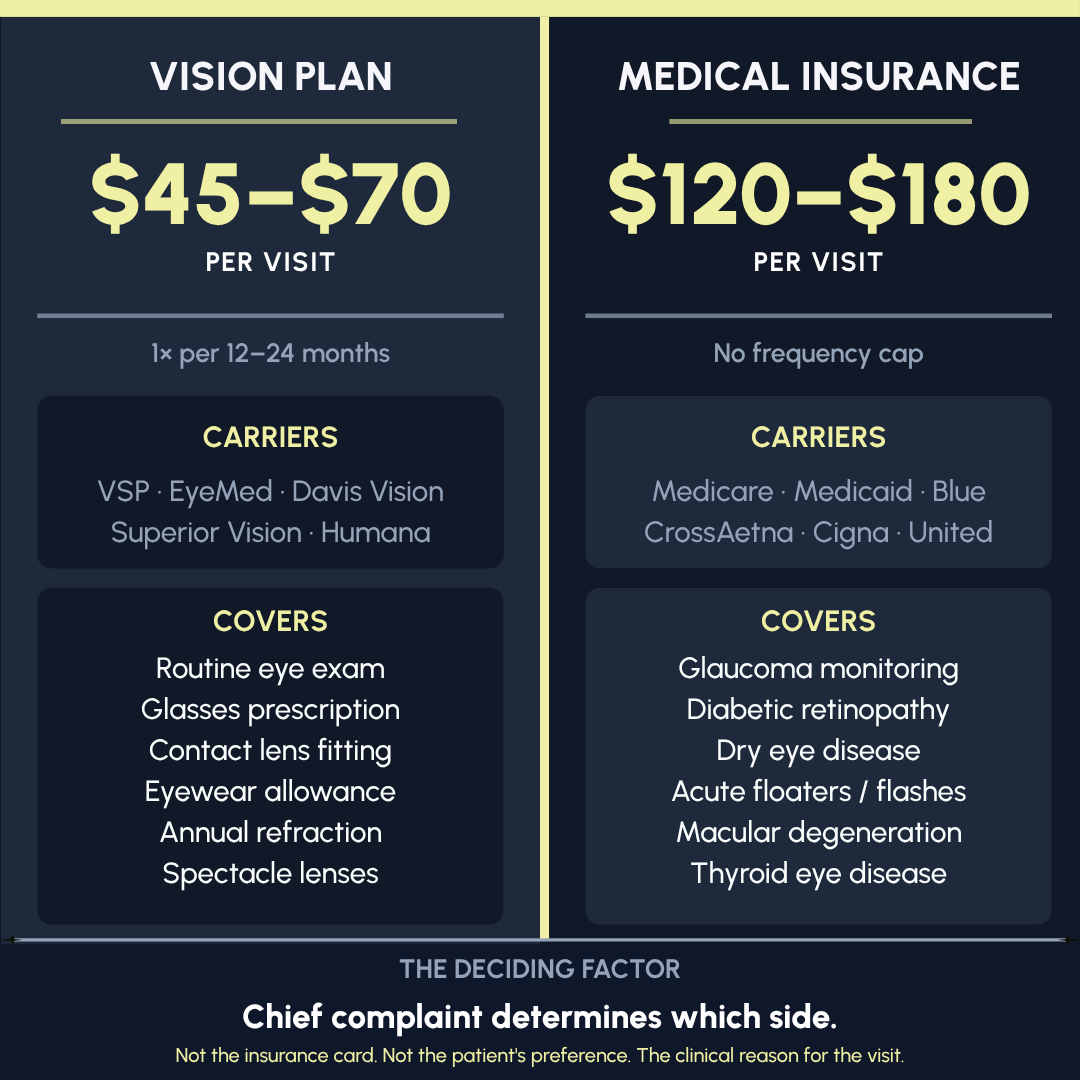
The short version: medical billing covers encounters involving a disease, injury, or systemic condition, and vision billing covers routine wellness exams and eyewear. Which one applies is determined by the patient's chief complaint and final documented diagnosis, not by what the patient prefers or which card they hand over.
Vision billing is for the routine encounter. A patient comes in for their annual exam, needs a new glasses prescription, or wants contact lenses evaluated. VSP, EyeMed, and Davis Vision cover that. They reimburse between $45 and $70 per visit and limit it to once a year or once every two years. No medical necessity required, no disease code driving the claim.
When a patient sees an out-of-network provider, these plans reimburse the member directly instead of paying the practice. See getting reimbursed by Davis Vision out of network for how one of them handles it.
Medical billing is for the clinical encounter. The patient's eyes are involved in something that requires medical evaluation: glaucoma monitoring, diabetic retinopathy screening, dry eye disease, sudden floaters, macular degeneration, thyroid eye disease. Medicare, Medicaid, and Blue Cross handle this. Reimbursement is $120 to $180 per visit with no frequency cap, because medical necessity determines the number of visits, not a plan's annual allowance.
📊 KEY STAT
The revenue gap between these two paths is $60 to $130 per visit. For a 30-provider optometry group seeing 25,000 annual encounters, systematically routing medical encounters to vision plans eliminates $200,000 to $275,000 in annual collections per location. That revenue does not disappear because of bad billing. It disappears because the wrong box was ticked at intake.
(Medical Billers and Coders, April 2026)
Here is what those two worlds look like side by side:
| Dimension | Vision Billing | Medical Billing |
|---|---|---|
| Insurance carriers | VSP, EyeMed, Davis Vision, Superior Vision, Humana Vision | Medicare, Medicaid, Blue Cross, Aetna, Cigna, United Healthcare |
| Reimbursement | $45 to $70 per visit | $45 to $70 per visit |
| Frequency limit | 1 exam per 12 to 24 months | None. Medical necessity determines visits. |
| What triggers it | Routine exam, refraction, glasses, contact lenses | Disease, injury, or systemic condition affecting the eyes |
| ICD-10 required? | No, for routine visits | Yes, to the highest level of specificity |
| Modifier 25 needed? | Rarely | Yes, for same-day E/M service and procedure |
| Yes, for same-day E/M service and procedure | Covered by the vision plan | Never covered by Medicare |
| Real examples | Annual eye exam, new Rx, contact lens fitting | Glaucoma, diabetic retinopathy, dry eye disease, acute floaters |
Before routing a visit, it helps to understand the difference between medical and vision insurance, since they are two separate systems built for different reasons.
What Determines Which Insurance to Bill?
The insurance you bill is set by the patient's chief complaint and final documented diagnosis. Not by which card they hand you, not by which plan is easier to file, not by what the patient thinks they are covered for. If the chief complaint is a routine exam or new prescription, bill the vision plan. If it is a disease, injury, or systemic condition affecting ocular health, bill medical insurance.
This is where most practices get into trouble, and it is not because they do not know the rule. It is because the rule gets applied after the wrong decision has already been made.
Picture the front desk on a Monday morning. A patient walks in. She has VSP. She says she needs her eyes checked. The front desk enters VSP, the encounter runs through vision billing, and 30 days later it pays $65. But the patient had mentioned she is diabetic, and a diabetic annual eye exam should have gone to Medicare at $155. That $90 difference does not get recovered. Nobody catches it. And it happens again the next day with a different patient.
The routing decision comes down to three things.
- The chief complaint. What does the patient say when they walk in, not what you assume or what you saw last time, but what they say today. "I need new glasses" is vision. "My vision has been blurry since last week and I have diabetes" is medical. "Something is in my eye" is medical and possibly urgent. This is the first filter and the most important one, and it needs to be captured before insurance is selected, not after.
- The final documented diagnosis. Even if a patient presents for something that seems routine, the exam may uncover a medical condition. When it does, the encounter changes. The chief complaint sets the likely path, and the diagnosis confirms it. If the diagnosis is a disease, the billing should be medical regardless of what happened at check-in.
- Payer-specific coverage rules. Each carrier has its own rules on top of the general framework. Medicare explicitly excludes routine exams and refraction. Most vision plans explicitly exclude treatment of eye disease. Your payer contracts are the final word on edge cases, so verify before assuming.
Here is how that plays out in real scenarios:
| Patient says at intake | Complaint type | Bill this insurance | Why |
|---|---|---|---|
| 'I need new glasses' | Routine | Vision plan | Routine refraction, no medical complaint |
| 'Annual exam, I have diabetes' | Medical | Medical insurance | Diabetic eye disease requires medically necessary annual screening |
| 'Something feels stuck in my eye' | Medical / Urgent | Medical insurance | Acute foreign body or corneal injury |
| 'I keep seeing flashes and floaters suddenly' | Medical / Urgent | Medical insurance | Possible retinal detachment, urgent evaluation required |
| 'Just my regular yearly checkup' | Routine | Vision plan | No stated medical complaint, routine wellness |
| 'My eyes are always dry and irritated' | Medical | Medical insurance | Dry eye disease is a diagnosed and treated medical condition |
| 'I think my prescription changed' | Routine | Vision plan | Refractive concern, no stated medical condition |
| Glaucoma follow-up (returning patient) | Medical | Medical insurance | Ongoing medical condition, monitoring is medically necessary |
When Both Insurances Apply: Coordination of Benefits
There is a separate situation worth understanding: when a patient has both medical and vision insurance and distinct services are performed in the same visit.
Say a patient presents with dry eye disease and also asks for a refraction for new glasses. The comprehensive medical exam goes to medical insurance. The refraction (CPT 92015) gets billed separately to their vision plan. Two separate services, two separate claims, both legitimate. This is called Coordination of Benefits, or COB. Most in-house billing teams do not do it. They file one claim to one plan and leave the rest on the table. The full mechanics of billing medical and vision for the same visit, including when a true primary and secondary sequence applies, are worth a read before you set up the split.
📊 KEY STAT
The COB approach recovers an average of $55 to $110 per qualifying encounter, and most practices miss it on every qualifying visit. Across a 30-provider group with 25,000 annual encounters, that abandoned COB represents $1.375M to $2.75M in forfeited revenue every year. (Medical Billers and Coders, April 2026; AOA Coordination of Benefits, September 2024)
⚠ COMPLIANCE
Billing both medical and vision for the same service is illegal under federal law, with civil monetary penalties up to $27,894 per false claim. COB is only legal when you bill each plan for a different, separately documented service performed in the same visit. When in doubt, bill one and self-pay the other.
(AOA, Coordination of Benefits, September 2024; CMS, Medicare Coverage of Optometry Services, OPHTH-003)
The Billing Decision Tree: Medical or Vision?
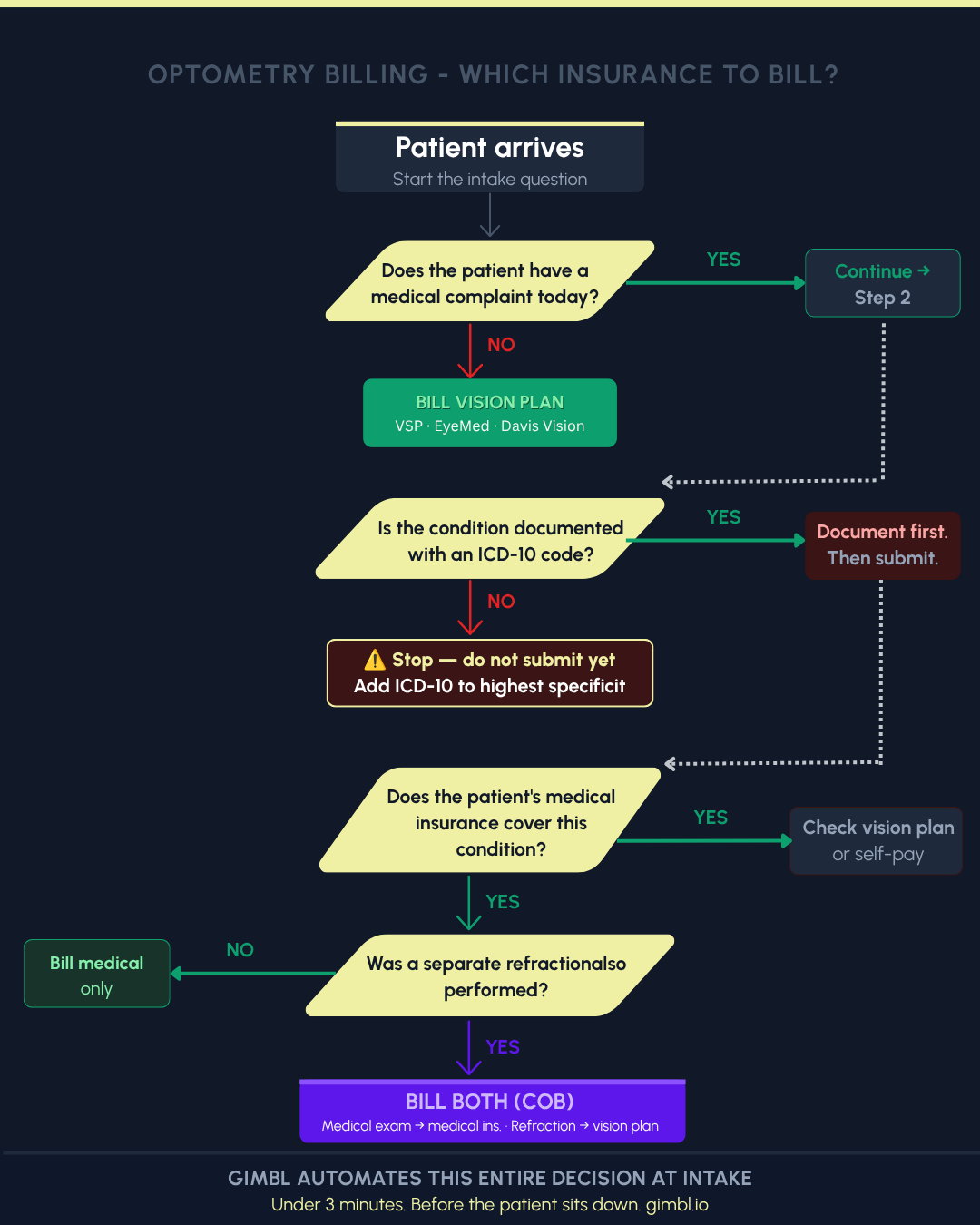
Knowing the rule is one thing. Having something your front desk can actually use in the moment is another. The decision tree below turns the medical vs vision routing call into a simple step-by-step process. It is built from AOA billing guidelines and CMS coverage rules. Put it at every intake station and train every front desk team member on it, because it is one of the fastest ways to reduce intake-level billing errors.
| Step | Ask this question | YES | NO |
|---|---|---|---|
| Step 1 | Does the patient have a medical complaint today? (disease, injury, systemic condition, acute symptom) | Go to Step 2 | Bill vision plan |
| Step 2 | Is the condition documentable with an ICD-10 diagnosis code? | Go to Step 3 | Cannot bill medical. Document the condition first. |
| Step 3 | Does the patient's medical insurance cover this specific condition? | Bill medical insurance | Check vision plan or collect self-pay |
| Step 4 | Does the patient also have a vision plan, and was a separate refraction performed? | Bill both via COB: medical exam to medical, refraction to vision plan | Single claim to medical only |
| Audit check | Does documentation support the chief complaint AND the billed code? | Submit clean claim | Fix documentation before you submit, not after |
QUICK TIP
Print this decision tree and laminate it at the front desk. It takes 30 seconds to walk through at intake and it prevents the kind of routing errors that cost $60 to $130 per visit and show up as denials 45 days later.
CPT Codes for Optometry Billing: The Essential 2026 Reference
Getting the insurance routing right is half the job. The other half is making sure the CPT code matches what was actually done in the room, because the wrong code gets the claim denied just as fast as the wrong insurance. New to the code set? Start with what CPT codes are, then use the reference below.
Optometrists have access to two code families. The 92xxx General Ophthalmological Service codes are exclusive to eye care providers. The 99xxx Evaluation and Management codes are used across all medical specialties and come into play for medically complex encounters where the documentation framework fits better than the ophthalmic codes. For a full breakdown of the eye exam codes themselves, 92002 through 92014 and when to use E/M instead, see the complete guide to CPT codes for eye exams.
Here is the complete reference for the codes every optometry practice bills regularly:
| CPT Code | What it covers | Patient type | Which insurance | What you need to know |
|---|---|---|---|---|
| 92002 | Intermediate exam, new patient | New | Medical or Vision | Anterior segment focus. Less comprehensive than 92004. Use when the exam does not include a dilated fundus evaluation. |
| 92004 | Comprehensive exam, new patient | New | Medical or Vision | Includes dilated fundus exam. Most common new patient code. One per patient per year is the standard. |
| 92012 | Intermediate exam, established patient | Established | Medical or Vision | Follow-up and monitoring visits: glaucoma checks, medication adjustments, interval exams. |
| 92014 | Comprehensive exam, established patient | Established | Medical or Vision | Most commonly billed established patient code. One comprehensive per year per patient is the general rule. |
| 92015 | Refraction | Either | Vision plan or self-pay ONLY | Never covered by Medicare. Bill the vision plan or collect from the patient directly. Always tell the patient before the exam. |
| 99202 to 99205 | E/M, new patient, office-based | New | Medical only | Use when the medical complexity of the encounter is better documented under E/M criteria than ophthalmic codes. |
| 99212 to 99215 | E/M, established patient, office-based | Established | Medical only | Alternative to 92014 for medically complex encounters. Requires MDM or time-based documentation. |
| 92310 to 92317 | Contact lens fitting services | Either | Vision plan typically | Covers spherical, toric, bifocal, and therapeutic lens fitting. Code to the specific lens type. |
| 92083 | Threshold visual fields | Either | Medical when indicated | Bilateral procedure. One fee for one or both eyes. Order only when medically necessary. |
| 92250 | Fundus photography | Either | Medical when indicated | Bilateral. Do not order for screening without medical necessity. Audit trigger |
⚠ IMPORTANT
92014 vs 99214 comes up constantly. Use 92014 for a standard comprehensive established-patient eye exam. Use 99214 when the encounter involves moderate-complexity medical decision-making that fits E/M documentation better. Never bill both on the same visit without Modifier 25. And if you are billing 99215 routinely, expect scrutiny, because the OIG flags over-use of the highest E/M level as an audit trigger.
Modifiers: The Part Most Practices Get Wrong
A modifier tells the payer something important about how the service was delivered. The wrong modifier, or a missing one, changes what gets paid. Here are the ones that matter most in optometry:
| Modifier | What it means | When to use it in optometry | What happens if you miss it |
|---|---|---|---|
| -25 | A significant, separately identifiable E/M service on the same day as a procedure. | Eye exam performed and a procedure done the same visit: dry eye treatment, foreign body removal, punctal plug insertion. | Claim gets bundled. Payer pays one service. You lose $90 to $150 per encounter. |
| -59 | Distinct procedural service not normally billed together. | Two procedures performed separately in the same visit, with documentation supporting each as distinct. | Overuse triggers OIG audit. Use only when documentation clearly supports a distinct service. |
| -24 | E/M service unrelated to a procedure during its global period | Office visit for a completely unrelated condition during the post-op period of a prior procedure | Claim denied as included in the global surgical period. |
| -55 | Post-operative management only | Co-managing cataract surgery. You are handling post-op care, not the surgery itself. | Must use the surgery date as service date. Required or claim processes incorrectly. |
| RT/LT | Right eye / left eye | Any unilateral procedure: laser, foreign body removal, plug insertion. | Ambiguous claim. Denial or significant processing delay. |
| E1-E4 | Upper/lower lid, right/left | Lid-specific procedures: punctal plugs, blepharoplasty | Use instead of RT/LT for anything involving the eyelids specifically. |
📊 KEY STAT
2026 updates to know: CMS set dual conversion factors effective January 1, 2026, at $33.57 for qualifying APM participants and $33.40 for all others. NCCI edits update quarterly. OCT and fundus photos on the same day now have specific bundling rules. New Demodex blepharitis ICD-10 codes took effect October 1, 2025. Check for code updates every January and every October. (CMS.gov 2026; AOA 2025-2026 Code Changes)
For the reference covering the most commonly billed optometry codes, see the vision billing codes guide.
Sources: AMA CPT descriptions; CMS fee schedules and coverage rules; AAPC optometry/ophthalmology CPT range 92002-92499; AOA billing and coding hub.
The 5 Most Common Optometry Billing Mistakes and What They Actually Cost
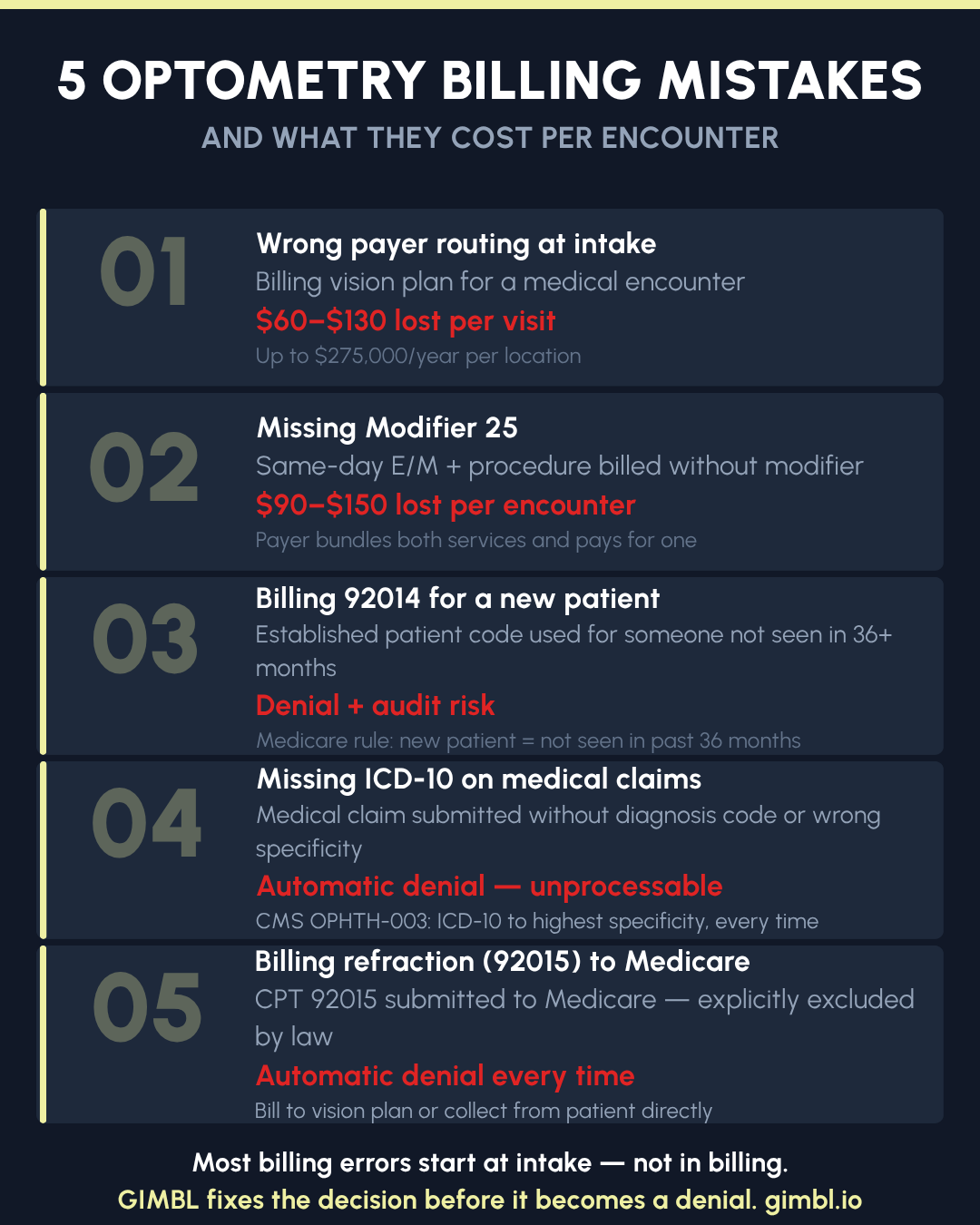
These five mistakes show up in practices of every size, from independent ODs to multi-location groups. The same errors appear, and most of the time they are not caught until a denial arrives 30 to 45 days later, by which point the rework costs $25 to $118 per claim and some portion of that revenue never comes back.
Mistake 1: Routing the Claim Based on the Insurance Card, Not the Chief Complaint
This is the most expensive mistake in optometry billing. A diabetic patient walks in with a VSP card. The front desk enters VSP. The encounter runs through vision billing. The practice gets $65 when it should have received $155. Nobody did anything wrong deliberately, they used the card the patient handed over. But the encounter, a medically necessary diabetic eye exam, should have gone to medical insurance.
📊 KEY STAT A practice with high diabetic or glaucoma volume where 85 percent or more of encounters are billed to vision insurance has a systematic misclassification problem. That pattern alone eliminates $200,000 to $275,000 in annual collections per provider location. (Medical Billers and Coders, April 2026)
Mistake 2: Not Adding Modifier 25 for Same-Day E/M and Procedure
An optometrist does a comprehensive eye exam and treats the patient's dry eye in the same visit. Both services get billed, but Modifier 25 is not added to the E/M code, so the payer bundles both services and pays for one. Per AOA guidance, both federal and private payers are actively scrutinizing this modifier. Used correctly, it protects reimbursement for both services. Missing it costs $90 to $150 per encounter, quietly and consistently, in practices that never notice the pattern.
Mistake 3: Billing 92014 for a New Patient
A patient who has not been seen in four years comes in, and the front desk checks them in as established out of habit. 92014 (established patient comprehensive) goes on the claim instead of 92004 (new patient comprehensive).
⚠ IMPORTANT
Medicare and most commercial carriers define a new patient as someone not seen by you, or any provider in your practice, within the past 36 months. Bill 92014 for a patient who qualifies as new and you are looking at a denial, reduced reimbursement, or an audit flag if the pattern repeats. Check new-vs-established status on every patient, every visit.
Mistake 4: Missing the ICD-10 Code on Medical Claims
A medical claim goes out without an ICD-10 diagnosis code, or with a code that does not match the documented condition. Under CMS billing and coding guidelines for optometrist services (OPHTH-003), that claim is denied as unprocessable. ICD-10 codes must be present on every medical claim and coded to the highest level of specificity. "H40.9, unspecified glaucoma" when the record shows "H40.1130, primary open-angle glaucoma, right eye, mild stage" is not just imprecise, it is a compliance risk. The right code, at the right specificity, on every medical claim, every time.
Mistake 5: Billing Refraction (CPT 92015) to Medicare
CPT 92015 is explicitly excluded from Medicare coverage under the Social Security Act, along with routine exams and eyeglasses. Billing 92015 to Medicare gets an automatic denial. More importantly, collecting for it without an Advance Beneficiary Notice (ABN) creates compliance exposure.
✅ QUICK TIP
For any Medicare patient, never bill 92015 to Medicare. Bill it to their vision plan if they have one, or collect directly from the patient. Get the ABN signed before the exam if they have Medicare only, tell them upfront that refraction is not covered, and document the conversation.
Where Billing Errors Actually Start: The Front Desk Problem
Nobody in optometry billing wants to say this plainly, so here it is. Every mistake in the section above, wrong payer, missing modifier, wrong patient type, none of it starts in billing. It starts at the front desk, at intake, before a single clinical note is written. Your billing team is not creating these problems. They are inheriting them.
Think about what the front desk is actually being asked to do: check patients in, handle phone calls, verify insurance, manage a waiting room, and answer questions from patients and providers. And somewhere in the middle of all that, in the 30 seconds it takes to check a patient in, they are making a clinical routing decision they were never trained to make, which is which insurance this patient's problem belongs to today. That decision gets made fast, under pressure, and when it gets made wrong, nobody knows for 45 days.
📊 KEY STAT Practices that corrected their intake-level billing workflow, without hiring additional billing staff, saw a 16 percent improvement in Net Collection Ratio within 90 days. The revenue was already there. It was being lost before billing ever saw the encounter. (Medical Billers and Coders, April 2026)
The 5-Question Intake Script That Prevents Most Routing Errors
The routing decision can be made correctly at the front desk, but only if the right questions are asked before the insurance is selected, not after. This script takes about 60 seconds and it prevents the most common and most expensive billing errors in optometry.
| Q | Ask this | Medical path | Vision path |
|---|---|---|---|
| Q1 | What is the main reason for your visit today? | Any disease, pain, injury, or systemic condition mentioned | 'Annual exam', 'new glasses', 'update my prescription' |
| Q2 | Have you had any eye problems, injuries, or new diagnoses since your last visit? | Yes to anything. Confirm medical path. | No. Continue to Q3. |
| Q3 | Do you have any conditions that affect your eyes? (diabetes, high blood pressure, autoimmune disease) | Yes. Bill medical insurance. | Yes. Bill medical insurance. |
| Q4 | Are you experiencing any pain, sudden vision changes, or discomfort right now? | Yes. Medical path, may be urgent. | No. Vision path confirmed. |
| Q5 | Which insurance would you like to use today? | Medical complaint confirmed above. Use medical insurance regardless of which card they offer. | No medical complaint. Use vision plan as stated. |
⚠ IMPORTANT
The patient's insurance preference does not override the clinical routing decision. A diabetic patient saying "just use my VSP" does not turn a medically necessary encounter into a routine vision visit. The practice, not the patient, is responsible for billing correctly. Billing vision for a medical encounter because the patient asked you to is still a billing error.
How to Fix the Medical vs Vision Billing Decision at the Source
The most effective fix for everything described in this guide is not training the front desk harder. It is removing the decision from the front desk entirely.
The right approach operates before a claim is built, before any of these mistakes has a chance to happen. It handles insurance discovery, eligibility verification, chief-complaint routing, CPT code recommendations, and payer path selection at the point of intake. It does not replace your billing team and it does not replace your EHR. It sits between the moment a patient walks in and the moment their encounter enters the revenue cycle, making sure every input is correct before billing ever touches it.
That distinction is also the test to apply when you compare optometry billing software, because most platforms work after the claim is built, not before it. And it is the same test when you weigh your billing model itself, whether to keep it in-house, hand it to an outsourced service, or automate the decision at intake. Our guide to optometry billing services breaks down those three options and where each one fits.
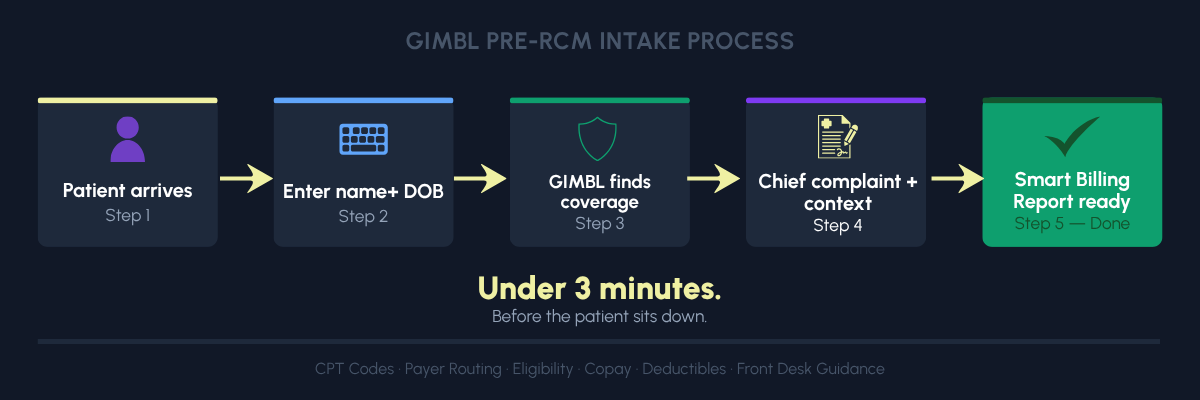
This is the problem GIMBL was built to solve. Even with the right intake script, consistent execution depends on your team performing correctly under real pressure, every patient, every shift, every new hire. One new front-desk person can undo months of training. GIMBL is a pre-submission billing decision tool built for independent optometry that makes the decision for you, before the appointment starts. Here is what the intake process looks like:
- Enter the patient's name and date of birth.
- GIMBL identifies all active insurance coverage automatically, across every carrier.
- Enter the chief complaint and visit context.
- GIMBL generates a complete Smart Billing Report: the CPT codes most likely to be approved, payer routing, eligibility, copay, deductibles, and specific front-desk guidance.
- Export it as a PDF or sync it directly to RevolutionEHR.
The whole process takes under three minutes, and all of it happens before the patient sits down. No guessing, and no 45-day surprises. It works alongside your existing EHR without replacing it.
▶ START HERE See how GIMBL routes the visit correctly before the claim exists. Start your free trial and create your account →
Frequently Asked Questions
What is the difference between medical and vision billing in optometry?
They are two separate systems, and the same patient can land on either. Medical billing covers eye diseases, conditions, or injuries, reimbursed at $120 to $180 by medical insurance with no frequency cap. Vision billing covers routine wellness exams and eyewear, reimbursed at $45 to $70 by vision plans with a limit of one exam every 12 to 24 months. The routing is set by the patient's chief complaint and documented diagnosis, not by which card they present.
When should an optometrist bill medical insurance vs vision insurance?
Bill medical when the chief complaint involves a disease, injury, or systemic condition: glaucoma, diabetic retinopathy, dry eye, acute floaters, macular degeneration. Bill vision when the visit is a routine wellness exam, refraction, or eyewear evaluation with no documented medical complaint. The chief complaint drives the decision, not the patient's preference and not which plan pays faster.
Can an optometrist bill both medical and vision insurance for the same visit?
Yes, but only for two different services. Billing both for the same service is illegal. If distinct services were performed, a medical exam billed to medical insurance and a separate refraction billed to the vision plan, then billing both is permitted with proper documentation. This Coordination of Benefits approach recovers $55 to $110 per qualifying encounter and is legal only when each claim covers a separately documented, distinct service.
What CPT codes do optometrists use for billing?
The most commonly used codes are 92002 and 92004 for new patient exams, 92012 and 92014 for established patient exams, 92015 for refraction (never covered by Medicare), and 92310 to 92317 for contact lens fittings. Medical encounters may use 99202 to 99215 E/M codes. V-codes (V2020 to V2799) cover spectacle lenses and contact lenses for optical dispensing.
Why do optometry claims get denied?
Most often because the wrong insurance was selected at intake, a CPT code was missing or incorrect, Modifier 25 was missing on a same-day E/M and procedure, an ICD-10 code was missing or not specific enough on a medical claim, or a new patient was billed as established. Most denials originate at intake, before billing begins.
What is pre-RCM in optometry?
Pre-RCM is the layer that operates before a claim is submitted. It covers insurance discovery, eligibility verification, CPT code recommendations, and payer routing at the point of intake, preventing billing errors from entering the revenue cycle instead of correcting them after a denial. GIMBL is a pre-submission billing decision tool built specifically for independent optometry practices.