
The 92083 CPT code is the most commonly doubled line in eye care diagnostics, and some guides ranking for this term today tell you to double it. One has a numbered step called Bill Per Eye. Another lists 92081 as the one eye code and 92082 as the both eyes code. Neither is correct, and the mistake is expensive quietly, because a duplicated visual field comes back as a reduced payment rather than a rejection, so nobody ever sees a denial to work.
The 92083 CPT code billed twice on one claim
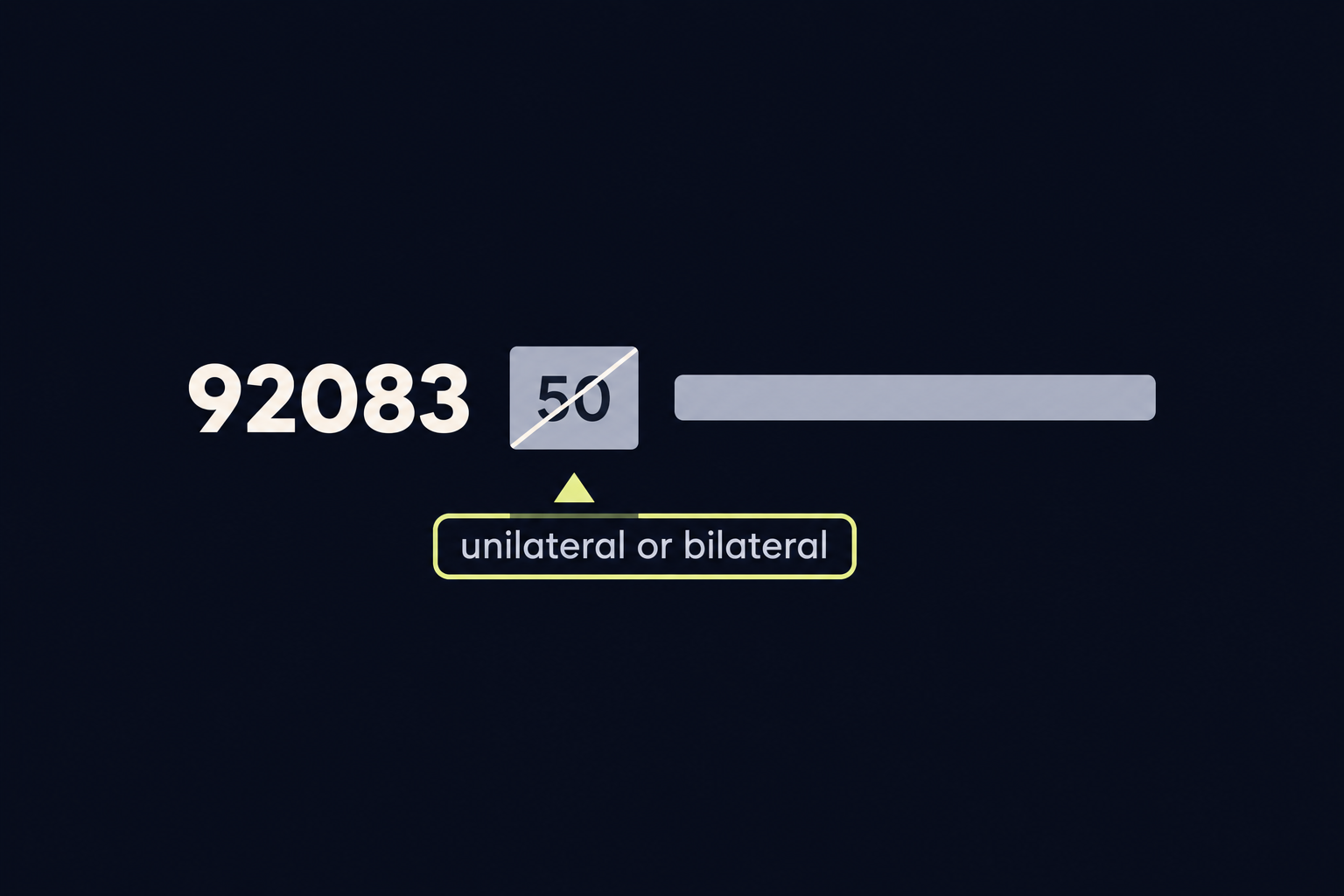
Read the descriptor and the argument is over. All three visual field codes are published as "visual field examination, unilateral or bilateral, with interpretation and report." Unilateral or bilateral sits inside the code itself, so one unit is the payment for the test whether the technician ran one eye or two.
The AAPC states it plainly: the payment established for the service is for one or two eyes, and you should only submit a bill for one service even if the doctor performed it on both eyes.
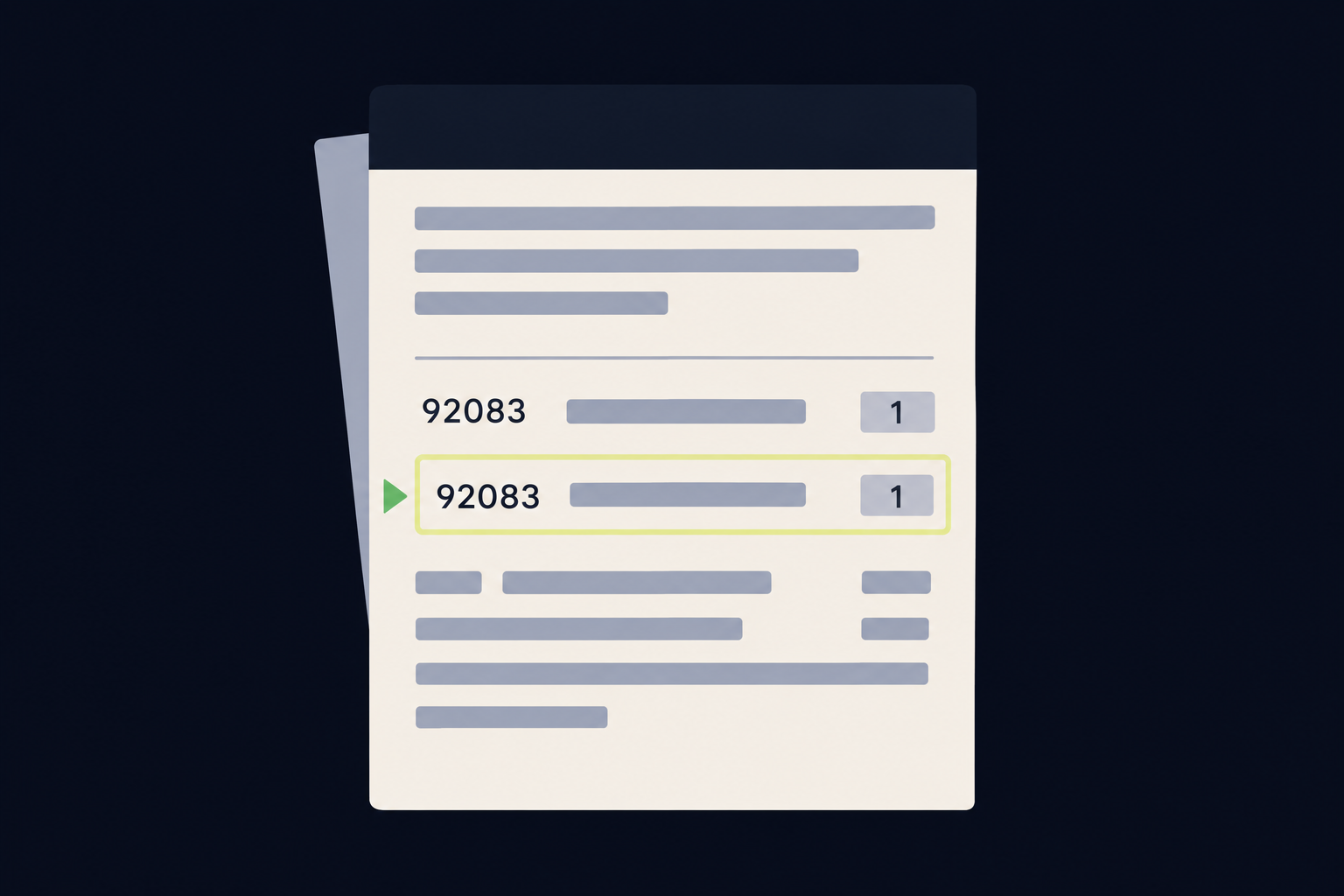
There is a second guard behind it. National Correct Coding Initiative edits bundle 92081, 92082 and 92083 to each other as mutually exclusive, and that pairing cannot be unbundled under any circumstances. A practice cannot report two visual field codes on one encounter, and cannot report the same one twice by adding a second line.
Key insight:
A second visual field line on the same claim is not aggressive billing, it is a line that was never payable. The first unit already covered both eyes.
92081 vs 92082 vs 92083, picked by eye count instead of test extent
The three codes are separated by how much of the field was tested, not by how many eyes were in the chair. Inverting that is what produces the duplicate lines.
92081 is limited, 92082 is intermediate, and 92083 is extended, which in practice is the full threshold test most practices run on a Humphrey or an Octopus. Each covers one eye or both, so eye count never enters the choice.
What does enter it is documentation. The record has to show what was tested, and the interpretation and report is not garnish, it sits inside all three descriptors. A printed field with no signed interpretation is a test performed and a service not completed.
Key insight:
A code chosen by counting eyes was chosen on the wrong axis, and the extent of the test is unsupported no matter which of the three was billed.
Modifier 50 added to a code that already covers both eyes
Modifier 50 marks a bilateral procedure. A code whose descriptor already says bilateral needs no marking, and adding the modifier claims a second unit that does not exist. The same goes for LT and RT, which split a service the code never split.
It is the same shape as the refraction problem, where a payer rule gets treated as a coding lever. Our guide to CPT 92015 and where the refraction charge lands walks that one.
One modifier does belong here, narrowly. Where a carrier pays for both a taped and an untaped field on the same day, usually a blepharoplasty workup, modifier 76 appends the second as a repeat procedure by the same physician. Most carriers pay one unit regardless. That is a carrier allowance, not permission to run the code twice.
Key insight:
Modifier 50 on a visual field is not a claim that gets paid more, it is a claim that tells the payer you read the descriptor and disagreed with it.
The confrontation field already paid for inside the exam
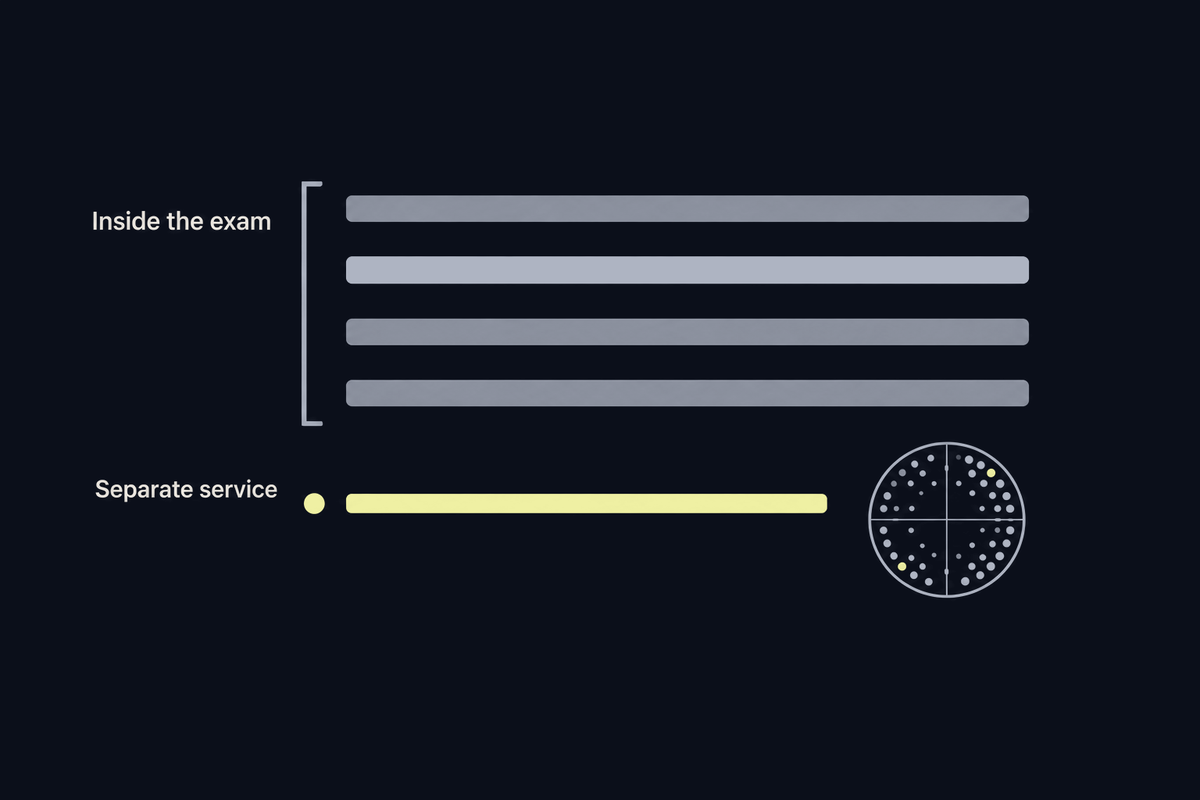
The other end of the same error is charging for a field the exam already covered. Medicare's Local Coverage Determination L33574, revision R12 effective September 19, 2019, is direct. Gross visual field testing, such as confrontation testing, is part of the general ophthalmological service and should not be reported separately.
Confrontation is the four quadrant check at the chair. It is part of a comprehensive exam and inside the exam code. The 92081 to 92083 family describes instrument perimetry with a printed result and a signed interpretation, a different service performed for a different reason.
A screening field with no supporting indication is not a billable diagnostic. That LCD names sixteen covered conditions, documented glaucoma and glaucoma suspect among them, and article A56799 extends the covered families to diabetic retinopathy, optic nerve disorders and retinal disease.
Key insight:
Confrontation is inside the exam and perimetry is a separate service. Billing the first or performing the second without an indication are the same mistake pointed in opposite directions.
Visual field testing billing sent to the vision plan
A visual field is a medical test. It exists because something is suspected or monitored, so it belongs on the medical plan even when the patient booked a routine appointment and handed over a vision card. Practices lose money here with no denial appearing, because the vision plan pays its flat routine rate and the diagnostic vanishes into it.
The routing has more than two branches, which is why it gets settled before the test runs.
| What was scheduled | What was performed | Where the visual field goes |
|---|---|---|
| Routine exam, vision plan on file | Field ordered on a finding during the visit | Medical plan, on the finding that prompted it |
| Medical visit, existing glaucoma or suspect | Field as part of monitoring | Medical plan, on the documented diagnosis |
| Routine exam, no finding, field run anyway | Screening field, no indication | Neither. Not a billable diagnostic |
| Blepharoplasty workup, taped and untaped | Two fields the same day | One unit unless the carrier allows a second with modifier 76 |
The visit reason decides the plan and the claim reflects what happened. The full fork is in our guide to where the medical and vision line falls.
Key insight:
A visual field on a routine claim is not a coding error, it is a routing error, and the reduced payment it produces will never appear in a denial report.
92083 reimbursement copied off a blog instead of the fee schedule
Two pages ranking for the 92083 CPT code print the same national Medicare figure, and practices now quote it as the rate. It is not the rate. Payment varies by locality and by facility versus office setting, and a national average is not an amount anyone is owed.
The source is the CMS Physician Fee Schedule lookup, run against your own locality. A figure copied from a vendor blog has no origin, so when a payer's allowed amount disagrees with it, nobody can tell whether the practice was underpaid or simply wrong.
Key insight:
Two blogs agreeing on a number is not a source. The fee schedule lookup for your own locality takes a minute and is the only figure worth writing down.
The bottom line on visual field CPT codes
The 92083 CPT code is simpler than the guides make it. One unit per session covers one eye or both. The choice between the three turns on the extent of the test. The modifiers that look useful create the problem. Confrontation is already inside the exam. And the decision that moves the most money is which plan the test belongs to, knowable before the patient reaches the machine.
The exam it is billed alongside sits in our reference on the CPT code for an eye exam, and the supporting diagnoses in the vision billing codes guide.
Key insight:
Every recurring visual field problem is decided before the test runs. By the time the remittance arrives, the only question left is how much of it to write off.
Deciding the plan at check in is what GIMBL is built to do. Create an account and route the next visit.
Frequently asked questions about the 92083 CPT code
Is 92083 billed per eye or per session?
Per session. The descriptor reads unilateral or bilateral, so one unit is the payment for the test whether one eye or both were examined. Submitting a second line for the second eye is a duplicate, not a second service.
Can you use modifier 50 with 92083?
No. Modifier 50 marks a bilateral procedure, and 92083 already covers one eye or both inside its own descriptor. LT and RT do not apply either. Modifier 76 is the only one that comes up, and only where a carrier pays for a taped and an untaped field on the same day.
What is the difference between 92081, 92082 and 92083?
The extent of the test. 92081 is limited, 92082 is intermediate, and 92083 is extended, which covers the full threshold testing most practices perform. All three cover one eye or both, so the number of eyes never decides the code.
Can you bill 92083 on the same day as an eye exam like 92014?
Yes. The diagnostic visual field codes are separately reportable from an eye visit code or an office visit code. What is not separately reportable is gross confrontation field testing, which is part of the general ophthalmological service.
How often can you bill a visual field test?
There is no fixed number. LCD L33574 ties frequency to changes in intraocular pressure, retinal damage and changes at the optic disc rather than to a count per year. Check your own Medicare Administrative Contractor's policy, because utilization guidance varies between them.
Does Medicare cover 92083?
Yes, where the indication is covered and documented. LCD L33574 names sixteen qualifying conditions including documented glaucoma and glaucoma suspect, and the related article lists the covered diagnosis families. A field with no supporting diagnosis is not covered.
Do vision plans cover visual field testing?
Visual fields are diagnostic rather than routine, so they belong on the medical side. Verify the specific plan before assuming, and route the test on the reason it was performed rather than on the card the patient presented.