
Davis Vision gives you sixty days to file. Most medical plans give you ninety to three hundred and sixty five. That gap is the whole problem, because a claim that goes to the vision plan first and comes back denied has usually spent most of its life before anyone at the practice knows it went to the wrong place.
Here is what the sixty days actually says, the two cases where it is longer, and the question at check in that decides which clock you are on.
If you are a patient rather than a practice, and you are trying to claim money back on an out of network visit, the page you want is the Davis Vision reimbursement form.
The Davis Vision timely filing limit is 60 days
The Davis Vision Provider Site Manual, in the Provider Responsibilities section, states it plainly:
"In general, providers are responsible for submitting all claims within sixty (60) days of the date services were provided, unless there is a longer time period required by law."
Two things in that sentence matter more than the number.
The clock starts at the date of service. Not the date you found the claim, not the date a denial came back, not the date the patient's coverage was finally confirmed. Sixty days from the exam.
"Unless there is a longer time period required by law" is not filler. It is the clause that produces every other number you will see quoted for Davis Vision, and it is why two practices can both be correct while giving you different answers.
The same sixty day rule appears in the older 2006 provider manual, at clause 12, and in the Participating Provider Agreement attached to it, which adds what happens when you miss it:
"Failure to submit statement within sixty (60) days of service delivery will, at Davis Vision's option, result in non-payment by Payer to the provider for the covered services rendered."
At Davis Vision's option. Not automatically, which is worth knowing before you write a claim off.
One thing to note about this number. Davis Vision has changed it before. The 2016 manual carries its own revision log, and the entry dated 1 April 2016 reads:
"Provider Responsibilities, updated claims submission from 180 days to 60 days; added New York Medicaid claims to be submitted within 90 days"
The window was cut by two thirds in a single revision. If your practice has a filing policy written before 2016, it is wrong, and it is wrong in the expensive direction. Check your current provider manual in the Versant Health portal rather than trusting a number anybody quotes you, including this page.
When the Davis Vision filing limit is 90 or 180 days
The "required by law" clause does real work. Two documented cases:
| Situation | Window | Where it is stated |
|---|---|---|
| General, all claims | 60 days from date of service | Davis Vision Provider Site Manual, cl. 14 |
| New York Medicaid | 90 days from date of service | Same manual, cl. 14a |
| Horizon NJ Health FQHC, New Jersey Medicaid | 180 calendar days from initial date of service | Horizon NJ Health, Davis Vision FQHC Vision Billing Guide |
Horizon NJ Health publishes it without hedging:
"Davis Vision must receive all claims within 180 calendar days from the initial date when services were rendered. If claims are not received within 180 calendar days from the initial date of service, claims will be denied for untimely filing."
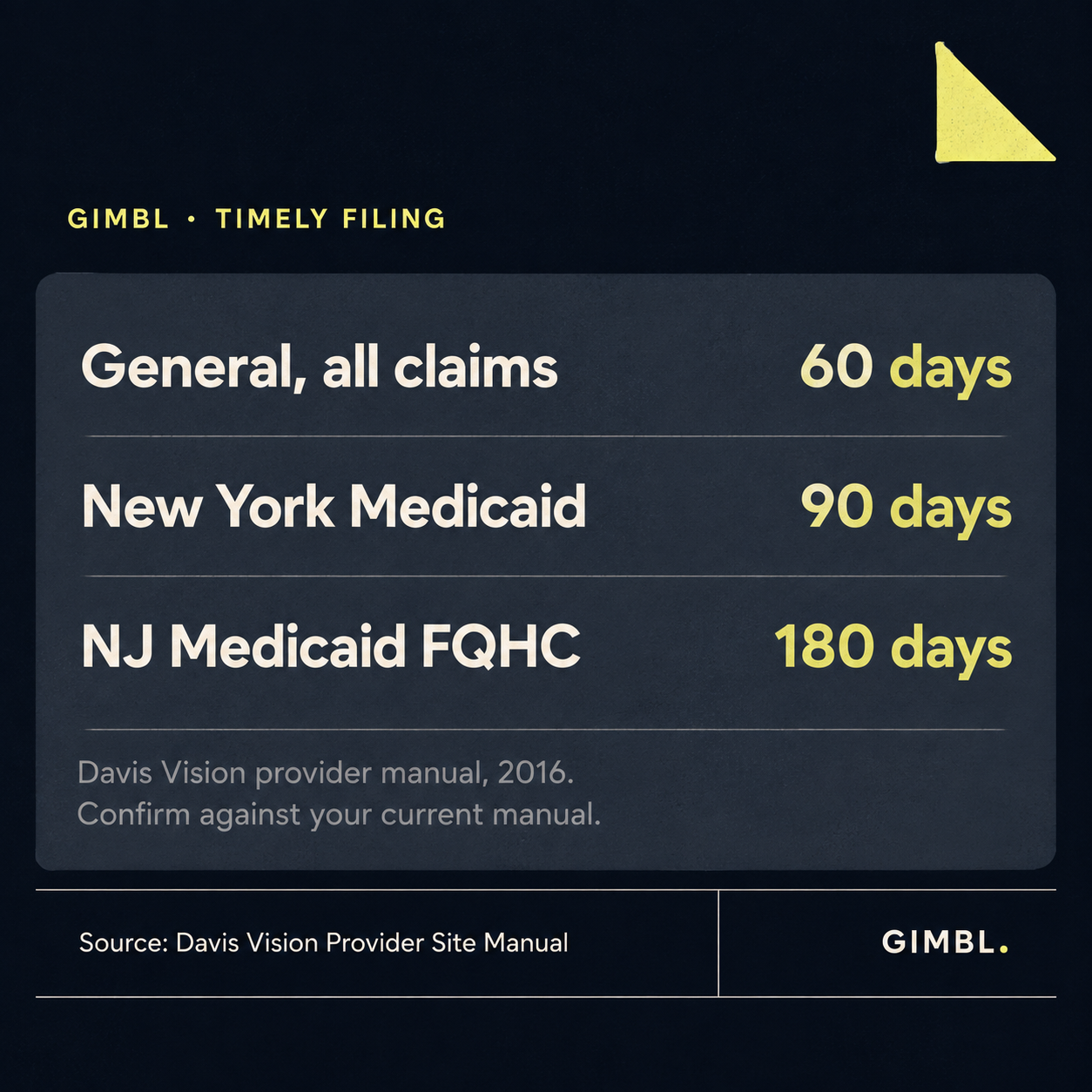
So the practical rule is this. Sixty days is the floor. If the patient is on a Medicaid product, the state's own filing rule may extend it, and the extension is real rather than a courtesy. If the patient is on a commercial Davis Vision plan, assume sixty and do not plan around an exception you have not read.
If you bill Davis Vision under more than one line of business, the sixty day rule is the one to build your process around. Building around 180 and discovering it does not apply costs you the claim.
Sixty days is not the Versant Health standard either. Superior Vision billing runs on ninety days from the date of service under the same parent company, so a practice that bills both is running two different clocks on two cards that arrive from the same organization. If you also bill VSP and EyeMed, their filing windows and their routing rules are different again. Those are covered separately in VSP billing and EyeMed billing.
Davis Vision or medical : the routing decision at check in
The filing window only matters once you know which plan the visit belongs to. That decision is not made in the billing queue. It is made at the front desk, before the patient sits down, and it is made by the reason for the visit rather than by the card in the patient's hand.
The Davis Vision provider manual is direct about where its own responsibility stops:
"When rendering or recommending diagnostic or therapeutic medical eye care services not included in the patient's routine eye care benefit administered by Davis Vision, participating providers must follow the protocol of the patient's medical plan, including coordination of care with the PCP when appropriate."
And on coordination of benefits:
"Davis Vision benefits are considered primary and there is no coordination of benefits (COB) with medical eye care services unless otherwise specified in Plan Benefit Descriptions."
Read that second quote twice. There is no automatic coordination between the vision benefit and the medical plan. A claim sent to the wrong one does not get quietly forwarded to the right one. It comes back, and the sixty days keeps running while it travels. Where benefits do coordinate, and in what order, is its own subject, and it is written up in coordination of benefits in optometry.
The three cases at the desk
| Whatthe patient says at check in | Which plan the visit belongs to | Whatthat means for the clock |
|---|---|---|
| Nothing is wrong, due for a check up, wants to look at frames | Davis Vision, routine | 60 days, straight forward |
| A symptom: blur that came on, dryness, floaters, something in the vision | The medical plan | The medical plan's own filing window, usually longer |
| Booked for glasses, and the exam documents pathology | The medical plan, for the medical service | The 60 day Davis clock started at the exam anyway |
The third row is where practices lose money, and it is the one no script catches, because the visit was routine when it was booked and stopped being routine somewhere between the waiting room and the slit lamp.
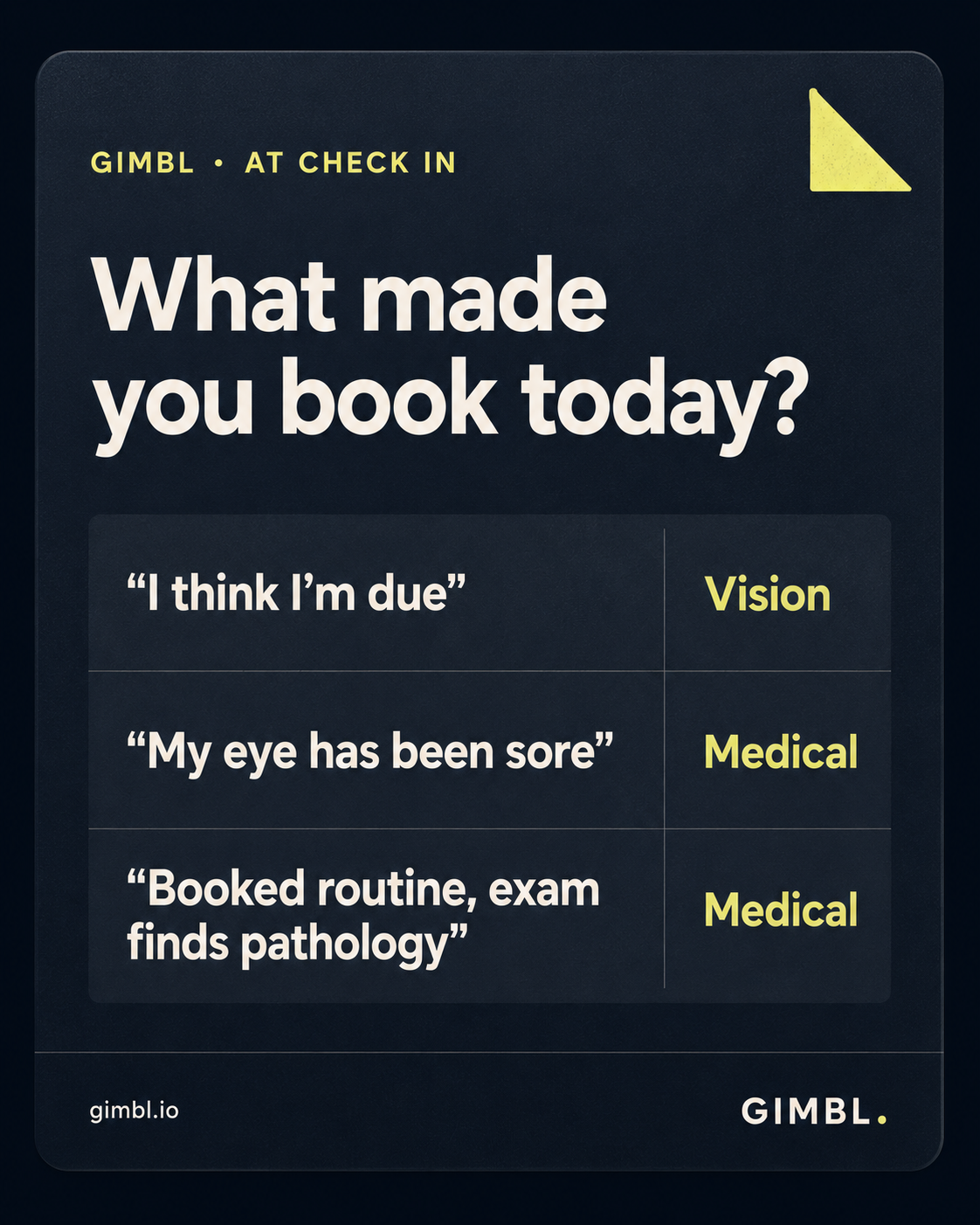
The question that sorts the first two rows is one sentence. What made you book today. If the answer describes a symptom, it is a medical visit, whatever card is in the hand. If the answer is "I think I'm due", it is routine.
For the third row there is no question that works at the desk, because the information does not exist yet. What works is a habit: the exam that turns medical gets flagged before the patient leaves the room, not when the remittance arrives.
Checking Davis Vision eligibility before the exam
The 2016 manual makes it a provider responsibility to check Davis Vision eligibility and obtain authorisation prior to the delivery of covered services, not after the claim is built. That is the same moment the routing question can still be answered for nothing. Once the patient has gone, both answers cost time taken out of the sixty days.
The codes this touches
CPT 92015 is refraction, and it has its own page here: CPT 92015 refraction billing. It is the single most common line item to sit on the wrong claim, because the refraction happens in almost every exam regardless of why the patient came in. The 2015 Davis Vision manual notes it as typically not covered under basic benefits, which means where it lands is a live question rather than a default.
CPT 92004 and 92014 are the comprehensive and established ophthalmological service codes. CPT 99202 to 99215 are the office visit evaluation and management codes. Which family the visit is billed under follows from what the visit was for, and that is the same decision as the routing decision, made at the same moment.
How a misrouted claim burns the Davis Vision 60 day window
Here is the sequence when the routing call is missed, and where the time actually goes.
- Day 0. Exam happens. Patient hands over the Davis Vision card. Claim is built against the vision benefit. The sixty day clock starts now.
- Day 3 to 10. Claim goes out.
- Day 20 to 40. Remittance comes back. Either the claim is denied, or it is paid at the routine rate for a visit that was not routine. The second outcome is worse, because nothing looks broken.
- Day 30 to 45. Somebody in the practice notices. This is the step with no fixed duration, and in a busy practice it is the longest one.
- Day 45 onward. The claim is rebuilt against the medical plan. That plan usually has a longer window, so this part often survives. What does not survive is any Davis Vision line that legitimately belonged on the vision claim, because that one is now against a clock that started at the exam.

The number that matters is not sixty. It is how many of the sixty are left when somebody first looks atthe remittance. In most practices that is between fifteen and thirty, and it is not a coding problem. It is a question nobody asked at check in.
Submitting Davis Vision claims: claim form, EDI and the portal
Davis Vision accepts claims in three formats: paper, EDI, and the Versant Health Provider Web Portal. A paper Davis Vision claim form still has to reach them inside the same sixty days, so post is the format with the least room in it.
NPI is required on all claim submissions. Davis Vision asks that the NPI is registered with the taxonomy and tax identification number, so its system identifies you correctly as an individual, a group or a facility. The name on the claim has to match the name on your W-9. Horizon NJ Health's guide notes this affects both timeliness and payment, which is a polite way of saying a name mismatch can stall a claim past its window.
Legacy provider identification numbers are still accepted, and Davis Vision's own guidance recommends continuing to use them, because the claims processing system uses that number for adjudication and payment.
The Davis Vision claims address
Davis Vision has published more than one claims address, and the appeals address is not the claims address. Take the current one from your provider portal rather than from any page, including this one. An appeal posted to the claims box is an appeal that does not arrive.
Davis Vision credentialing : the completion date is the claims date
This one costs practices real money and almost nobody publishes it.
When Davis Vision completes credentialing, the application completion date does more than confirm you are in network. Horizon NJ Health's guide states it directly:
"The application complete date will be entered into the Davis Vision database and claims system as the date the provider is able to provide treatment and submit claims for service to Davis Vision."
A new associate seeing Davis Vision patients before that date is generating claims that cannot be paid, and no amount of timely filing fixes it.
The rest of the enrollment timeline is worth planning around:
- A Network Development Specialist makes contact within 15 business days of a request to join.
- The full enrollment process may take up to 90 days.
- Credentialing runs through CAQH, with primary source verification by Davis Vision's credentialing verification organization.
- If the CAQH application is incomplete, Davis Vision makes three outreach attempts within 30 days, and rejects the application if it is not updated in that window.
Ninety days is a quarter. If you are hiring an associate for January, the paperwork starts in October.
Appealing a Davis Vision claim denied for untimely filing
There is one level of appeal, and only one. Davis Vision renders a decision within 30 business days of receiving the appeal request, and there is no second level.
The appeal goes to the Complaints and Appeals Department, not to the claims address. Supporting documentation matters here, and proof of timely filing is the document that does the work: a clearinghouse acknowledgement, an EDI receipt, a dated submission record. An appeal that asserts the claim was filed on time without showing it is an appeal that fails.
For provider disputes more generally, the 2016 manual sets a 60 calendar day window from receipt of the decision being disputed, in writing.
One appeal, thirty business days, and the burden is on you to prove the date. That is a thin margin, and it is another reason the routing call at check in is worth more than any process downstream of it.

The one thing to change tomorrow
Sixty days is not a lot of room, and almost none of it is spent on the part anyone controls. It is spent waiting to find out the claim went to the wrong plan.
The check itself is one question at the desk. What made you book today. If you would rather that question was answered before the claim is built rather than after it comes back, that is what we made: gimbl.io/auth/register
Davis Vision timely filing FAQ
What is the Davis Vision timely filing limit?
The Davis Vision Provider Site Manual sets sixty days from the date services were provided, unless a longer period is required by law. New York Medicaid claims are set at ninety days in the same clause. Some state Medicaid products run longer, and Horizon NJ Health publishes 180 calendar days for Davis Vision FQHC claims in New Jersey. Confirm the current figure in your Versant Health provider portal, because Davis Vision reduced this window from 180 days to 60 days in a 2016 revision.
How do I submit a claim to Davis Vision?
Paper, EDI, or the Versant Health Provider Web Portal. Your NPI is required on every submission, registered with your taxonomy and tax identification number, and the name must match your W-9.
Where do I mail a Davis Vision claim?
Davis Vision has used more than one mailing address, and the appeals address is separate from the claims address. Take the current one from your provider portal. Posting an appeal to the claims box is a common way to lose one.
How do I check Davis Vision eligibility before the exam?
The provider manual makes it a provider responsibility to verify eligibility and obtain authorization prior to the delivery of covered services, not after. Eligibility checked at check in is also the moment the medical versus vision routing question can still be answered cheaply.
When can a newly credentialed provider start billing Davis Vision?
From the application completion date, which Davis Vision enters into its claims system as the date the provider can treat and submit claims. Services delivered before that date are not payable. Allow up to ninety days for the full enrollment
process.
Can I appeal a Davis Vision claim denied for untimely filing?
Yes, once. Davis Vision has a single level of appeal and renders a decision within 30 business days of receiving the request. Include proof of timely filing, because the burden of showing the submission date sits with the practice.
Does Davis Vision coordinate benefits with the patient's medical plan?
The provider manual states that Davis Vision benefits are considered primary and that there is no coordination of benefits with medical eye care services unless a specific Plan Benefit Description says otherwise. A claim sent to the wrong plan is not forwarded to the right one.