
Most optometry billing software works after the claim is built. The most expensive eye care mistakes happen before it, and that gap is the whole story.
Every independent eye care practice reaches the same point. Claims are slow, denials keep circling back, the front desk is stretched thin, and someone finally says it out loud: we need better billing software. The market is happy to answer. Search for optometry billing software and you will find a long list of platforms promising cleaner claims, faster payment, and less paperwork. Most of them deliver on that. Very few of them address the step where eye care practices actually lose the most money.
This is a practical guide to what optometry billing software does, the features that genuinely matter for an eye care practice, how it fits with the rest of your systems, and the one gap that almost every option on the market leaves open.
What optometry billing software actually does
Optometry billing software is any platform that helps a practice submit claims to vision plans and medical carriers and collect on them. In practice that covers a wide range of jobs, and no single product does all of them equally well. Some verify eligibility and benefits before the visit. Some suggest or scrub CPT and HCPCS codes. Some route claims to a clearinghouse and track their status. Some post payments, reconcile remittances, and flag denials for rework.
The category feels crowded because a full platform usually bundles several of these functions together, while a point solution does one of them well. What matters for a practice is not how many boxes a product ticks, but whether it covers the specific step where your revenue is currently slipping. Underneath the feature lists, most tools are built on the same assumption, and it is worth naming that assumption early because it is where eye care gets left behind.
The pieces of a vision medical billing software stack
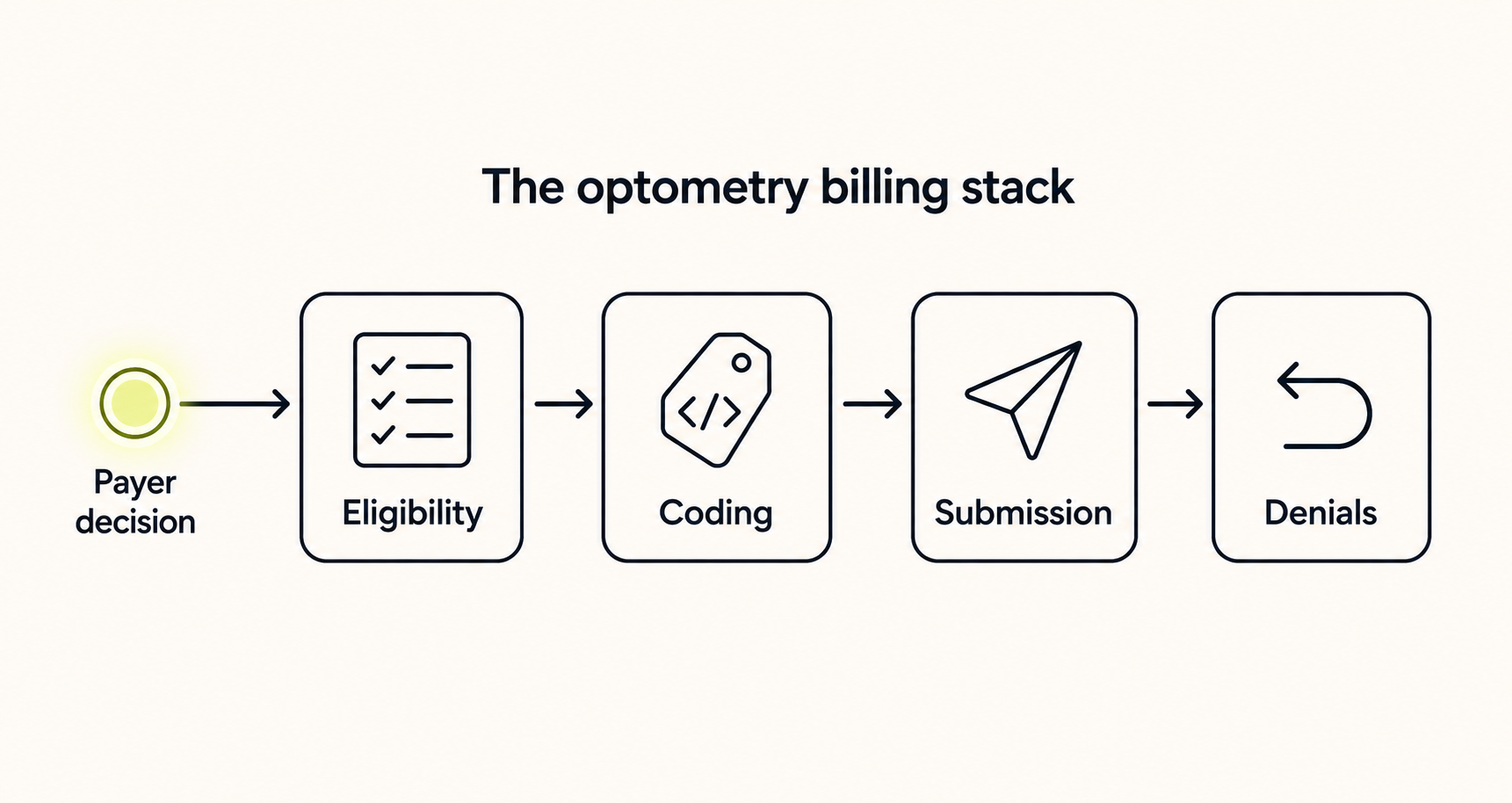
It helps to see billing as a sequence of stages rather than a single product, because a claim passes through all of them and can fail at any one. Vision medical billing software tends to cover the back half of this sequence well and the front half barely at all.
Eligibility and benefits verification comes first, confirming what each plan actually covers before the patient sits down. Coding support comes next, matching the exam and materials to the right codes, which the vision billing codes guide lays out in full. Then claim submission and clearinghouse routing send the claim to the payer and track its status. Finally, payment posting and denial management handle what comes back, working rejections and reconciling what was paid.
Notice where the effort concentrates. Most platforms are strongest at submission, tracking, and denial work, the part of the process that runs on decisions already made earlier in the visit. That is useful, but it is the second half of a story whose first half is where eye care practices bleed revenue.
What to look for in billing software for an eye care practice
When practices compare options, the feature grids blur together. Integrated billing, patient management, automated claims, reporting dashboards, every vendor lists the same things. A few criteria actually separate software built for eye care from a general medical billing tool that was adapted to it.
The first is whether it understands the medical versus vision split. Eye care is the one specialty where the same visit can belong to two entirely different payer types, and a platform that treats every claim as a single-payer medical claim will miss the routing that drives most optometry denials, a distinction the American Optometric Association documents in its billing guidance and one the guide on the difference between medical and vision insurance breaks down in plain terms. The second is eye-care-specific coding, since the 92000 series, the refraction rules, and the vision-plan S-codes maintained by the American Medical Association and coded per AAPC conventions are not part of a generic billing engine. The third is how much manual work the software removes from the front desk versus how much it simply moves downstream to a biller.
$60 to $130
The per-visit gap when a medical visit is routed to the vision plan. No downstream software recovers it, because the claim was never rejected
Vision billing software and medical billing: why eye care needs both
Here is what makes eye care different from every other specialty a billing platform serves. In most of medicine, a visit has one payer. In optometry, a single visit can carry a routine piece and a medical piece, and they belong to different insurers. A vision plan is a wellness and materials benefit, covering the routine exam, the refraction, and glasses or contacts. A medical plan covers the eye as a medical organ, for symptoms, injury, and disease.
That means good eye care billing is not vision billing software or medical billing, it is both, applied to the right part of the same visit. The dry eye workup bills to the medical carrier. The refraction bills to the vision plan. A platform that cannot tell those apart, or that leaves the decision entirely to whoever is at the front desk, is not really built for the specialty, whatever the marketing says. The plan-specific detail behind this shows up clearly in the VSP billing guide and the EyeMed billing guide.
The gap most optometry billing software misses
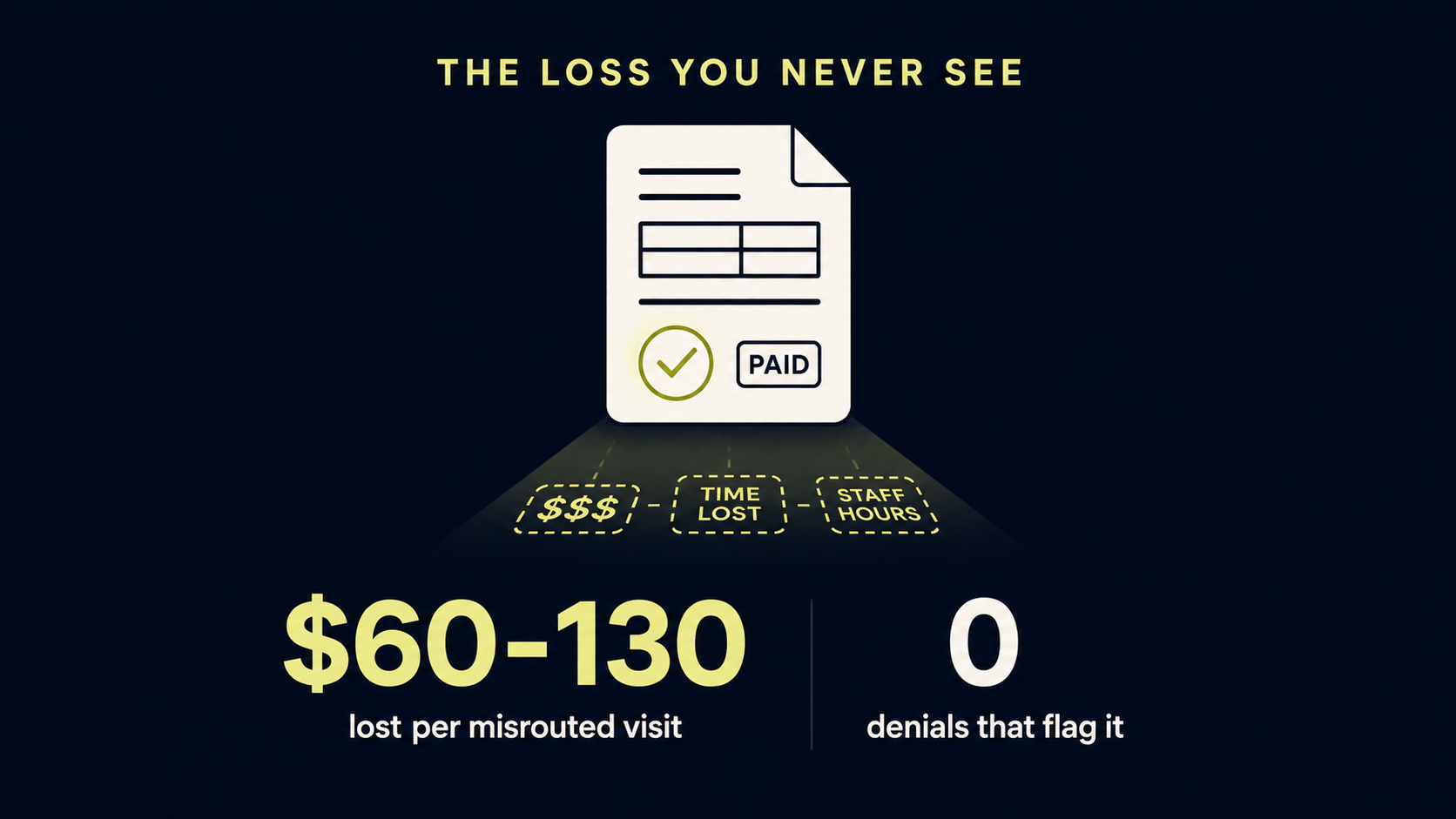
Here is the pattern underneath all of it. Almost every optometry billing platform operates after a claim has been created. It scrubs the claim, submits the claim, tracks the claim, and works the denial when the claim comes back. All of that assumes the most important decision was already made correctly: which payer the visit belongs to.
That decision is made at the front desk, in about thirty seconds, before any claim exists. When it is wrong, a medical visit gets billed as routine vision. The claim does not deny. It pays, cleanly, at the lower rate, and no scrubbing tool downstream flags it, because there is nothing wrong with the claim except the payer it was pointed at. As the Centers for Medicare and Medicaid Services framework makes clear, a claim is only ever as correct as the payer it was built for. The loss never appears in a denial report, so the tools built to catch denials never see it.
0 denials
what a misrouted claim triggers, which is exactly why downstream optometry billing software cannot catch it.
This is the gap GIMBL was built to close. It is a pre-submission decision layer, not another claim scrubber. Before the visit starts, it confirms new versus established status, surfaces every active plan the patient holds, and recommends the correct CPT codes for the payer the visit actually belongs to. The routing is decided when it can still be changed, rather than corrected weeks later when it cannot. Pairing GIMBL with whatever handles your submission and denials is how a practice closes the leak that ordinary optometry billing software leaves open.
How billing software fits with your EHR and clearinghouse
A billing platform is only as useful as its fit with the rest of the practice. Integration is the piece practices underestimate most, because software that does not connect cleanly to the EHR and the clearinghouse ends up creating duplicate data entry, which is exactly the manual work it was supposed to remove.
The two connection points that matter are the EHR, where the encounter and diagnosis live, and the clearinghouse, where the claim goes out. Software that sits between them and passes clean data both directions saves real time. Software that requires re-keying the same patient and insurance details is adding a step, not removing one. When you evaluate any option, trace one full visit through it, from check-in to submitted claim, and count how many times the same information has to be entered by hand. The bundling and coordination rules that govern a dual-coverage visit are worth understanding first, and the coordination of benefits guide covers them.
Software or a billing service: which fits your practice
One more fork worth naming. Some practices reach for optometry billing software, and others hand the work to a billing service. Both can work, and the choice is less about which is better and more about where your bottleneck is.
If you are weighing that call, our guide to optometry billing services compares the in-house, outsourced, and automated models side by side and shows where each one fits.
Outsourcing to a service moves the labor off your team, but it does not fix a routing decision made at your front desk, because the service inherits whatever payer and diagnosis were chosen at intake, the same as your own billers would. Automating the front-end decision keeps the work in house but removes the guesswork that creates the rework in the first place. Many practices end up doing both, using software to get the decision right up front and a service or in-house team to carry the claim the rest of the way. The full picture of how these choices fit together lives in the complete optometry billing guide.
Frequently asked questions
What is optometry billing software?
Optometry billing software is a platform that helps an eye care practice submit claims to vision plans and medical carriers and collect on them. It typically covers eligibility verification, coding support, claim submission and clearinghouse routing, and denial management. Most products specialize in one or two of these rather than all of them, so the right choice depends on where your practice is losing time or revenue.
What should optometry billing software do for an eye care practice?
At a minimum it should understand the medical versus vision split that is unique to eye care, support the eye-care CPT and HCPCS codes, and integrate cleanly with your EHR and clearinghouse so it removes manual entry rather than adding it. The highest-value platforms also help get the payer routing right before the claim is created, which is where most optometry revenue is quietly lost.
What is the difference between vision billing software and medical billing software?
Vision billing software is built to bill routine wellness and materials benefits to vision plans, while medical billing software is built to bill the eye as a medical organ to medical carriers. Eye care needs both, because a single visit can contain a routine piece and a medical piece that belong to different payers. Software that handles only one side will misroute the other.
Why do optometry claims still get denied even with billing software?
Because most billing software works after the claim is built, and the most common eye-care errors happen before it, at check-in, when the payer is chosen. A misrouted claim often does not deny at all. It pays at the lower rate, so scrubbing and denial tools never flag it, and the loss never appears in a report.
Does optometry billing software replace an EHR?
No. Billing software works alongside the EHR rather than replacing it. The EHR holds the encounter and diagnosis, and the billing software handles the claim. The value comes from how cleanly the two connect, which is why integration is one of the most important things to evaluate before you buy.