
Most practice owners start looking for optometry billing services at the same moment: a stack of unworked denials, an aging report creeping past 45 days, and a front desk that is already stretched too thin to chase any of it. The instinct is to hand the whole problem to someone else. That can be the right call. But "billing services" is a broad label that covers three very different models, and choosing the wrong one is how practices end up paying a percentage of every collection for work they could have prevented in the first place.
This guide breaks down what optometry billing services actually do, why eye care billing is harder than general medical billing, the real cost of each option, and how to decide between outsourcing the work and automating it before it ever becomes a problem.
What optometry billing services actually cover
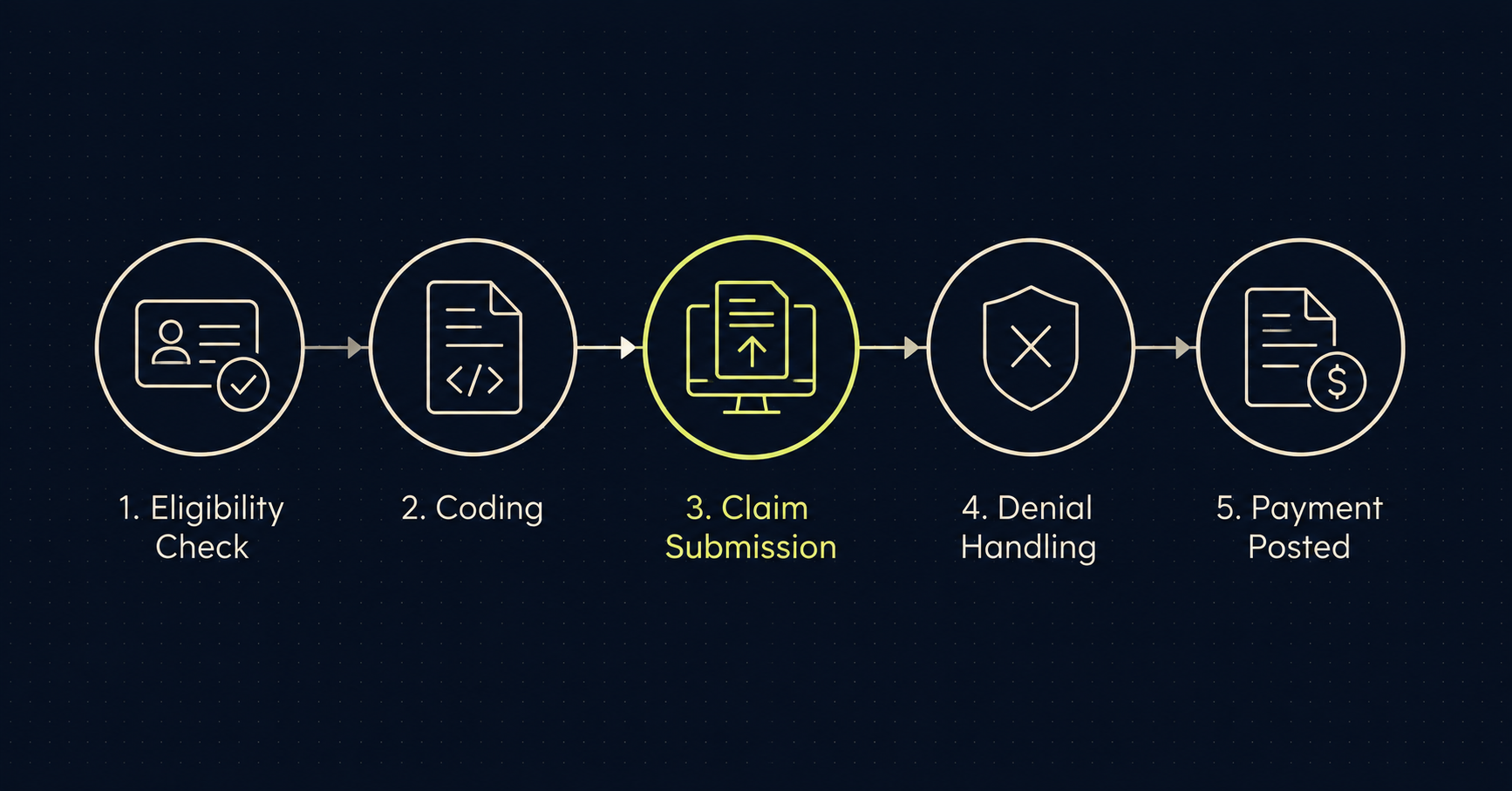
At their core, optometry billing services take the claim off your plate from the moment a patient checks out to the moment the payment posts. A full-service provider usually handles eligibility and benefits verification, charge entry and coding, claim submission, denial management and appeals, payment posting, patient statements, and accounts receivable follow-up. Some also report on the numbers that tell you whether any of it is working, like net collection rate, days in AR, and first-pass acceptance.
Not every provider does all of it, though, and that is where practices get caught. A coding-only service will clean up your codes but leave submission and follow-up to you. A full revenue cycle management partner takes the entire cycle. So when you compare optometry billing companies, the first question is not price. It is scope: which parts of the cycle are actually being handled, and which quietly stay your problem.
KEY TAKEAWAY
Optometry billing services range from coding-only help to full revenue cycle management. Confirm exact scope before you compare prices, because the gaps become your staff's problem.
Why optometry billing is harder than general medical billing
Every specialty thinks its billing is uniquely painful. Optometry has a fair claim to it, because eye care is one of the only fields where the same patient can be billed to two completely different insurance systems on the same day.
A patient walks in for a routine exam and glasses, which is a vision plan claim. During that exam you find early diabetic retinopathy, which is a medical claim to their major medical carrier. Those two systems use different codes, different fee schedules, different rules, and different definitions of what is even covered. A general medical billing service without strong optometry experience can miss the vision side, mishandle the payer routing, or fail to recognize when a medical encounter should move off the routine vision benefit. That last mistake is the most expensive one in the field, because a claim that pays cleanly at the wrong rate never shows up on a denial report for anyone to catch.
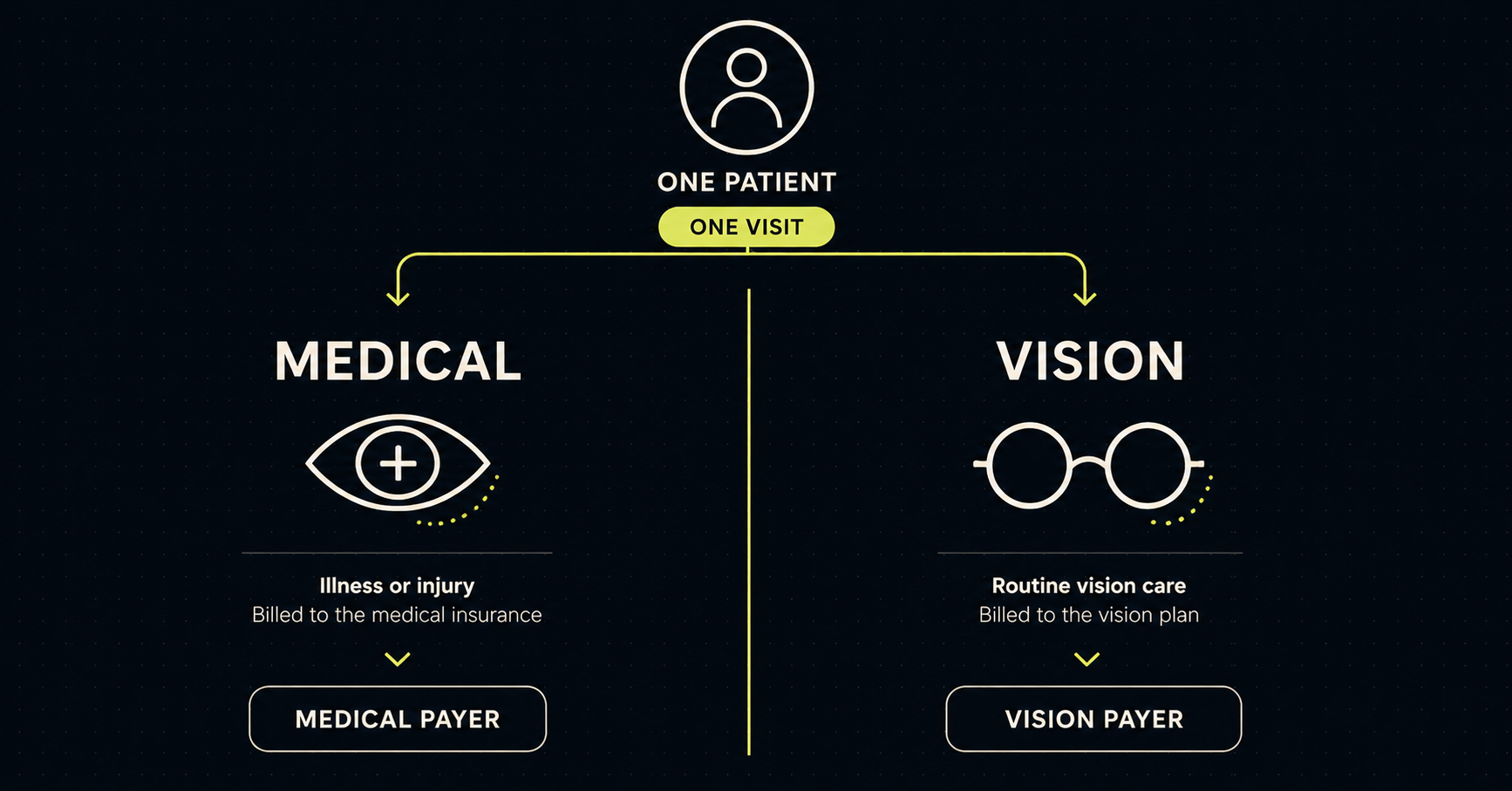
💡 INSIGHT The work that protects your revenue happens before the claim is built, in the decision about which payer a visit belongs to and which codes apply. A denial can at least be worked. A visit billed to the wrong plan that pays at the lower rate never gets flagged, so nobody ever recovers it.
This is why generic optometry medical billing is not enough on its own. If you want the full picture of how those codes break down, our guide to vision billing codes walks through the S-codes, V-codes, and the routing gap in detail, and the plan-specific rules are covered in our breakdowns of VSP billing and EyeMed billing.
The three models: in-house, outsourced, and automated
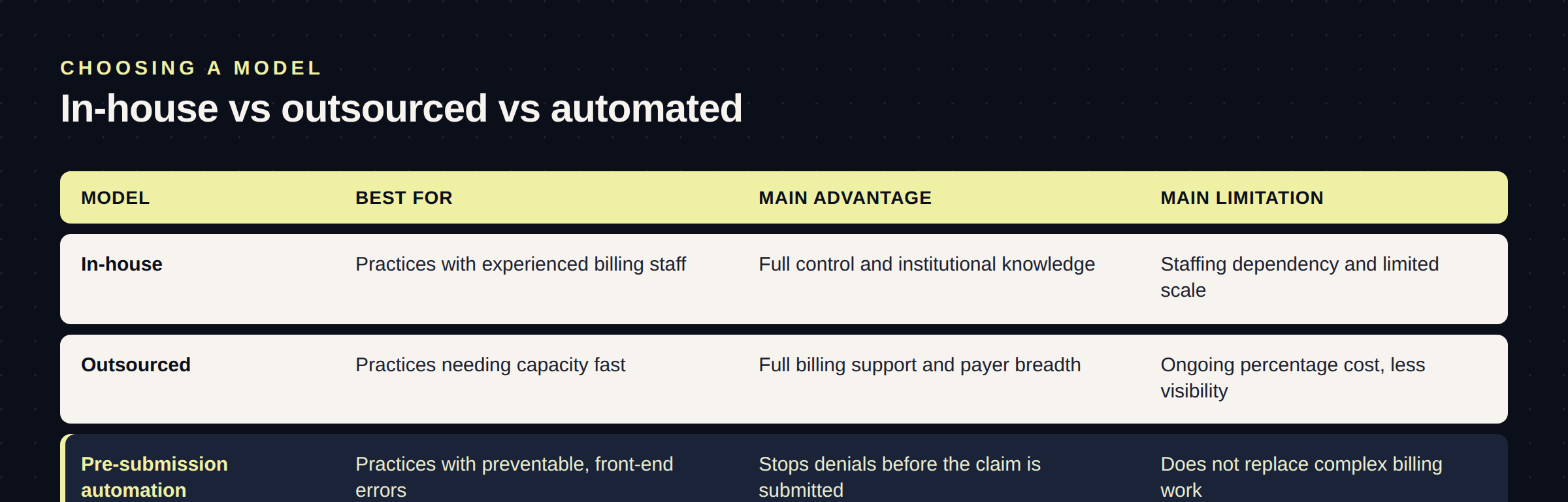
Almost every optometry billing setup falls into one of three models. They solve different problems, and the best-run practices increasingly blend them. In-house billing gives you control. Outsourcing gives you more hands. Automation tackles something different, which is preventing avoidable work from ever reaching the billing team in the first place. Here is how each one really plays out.
In-house billing
Your own staff handle the claims. The upside is control and institutional knowledge, since your biller knows your doctors, your payers, and your patients. The catch is fragility. When your one billing person takes vacation, gets sick, or leaves, your cash flow tends to leave with them. In-house billing also only scales by hiring, and experienced optometry billers are hard to find and expensive to keep. For a single-location practice with steady volume, it can work well. For a growing one, it becomes a bottleneck.
Outsourced optometry billing companies
You hand the cycle to an external team, usually for a percentage of collections. Outsourcing billing in optometry solves the staffing problem quickly and gives you a team that has seen more payers than any single in-house biller ever will. The tradeoffs are real, though. You lose some visibility, you are one client among many, and a service paid on a percentage of collections has little incentive to reduce the number of claims that need working. They make their money on volume, not on prevention.
⚠ WATCH FOR
A billing company paid on a percentage of collections earns more when more claims need working. That is not dishonesty, it is the incentive built into the model, and it is the reason prevention rarely comes from the people paid to clean up after the fact.
Pre-submission automation
The newest model does not replace your biller or your billing company. It moves the intelligence to the front of the cycle, before a claim is ever submitted, so that fewer claims need working at all. Software checks eligibility, flags the right payer and the right codes, catches the routing and documentation problems that create denials, and lets clean claims through the first time. Instead of paying someone a percentage to chase denials after the fact, you prevent a large share of those denials from being created.
This is the category GIMBL was built for. It is a pre-submission billing platform for independent optometry that makes the payer and coding decision correct before the claim goes out, rather than cleaning it up after the remittance comes back. It works alongside an in-house biller or an outsourced service, and it goes after the part of the problem the percentage-of-collections model has no reason to fix.
What to look for in optometry billing services
Whichever model you lean toward, the same handful of questions separate a service that grows your collections from one that just processes claims.
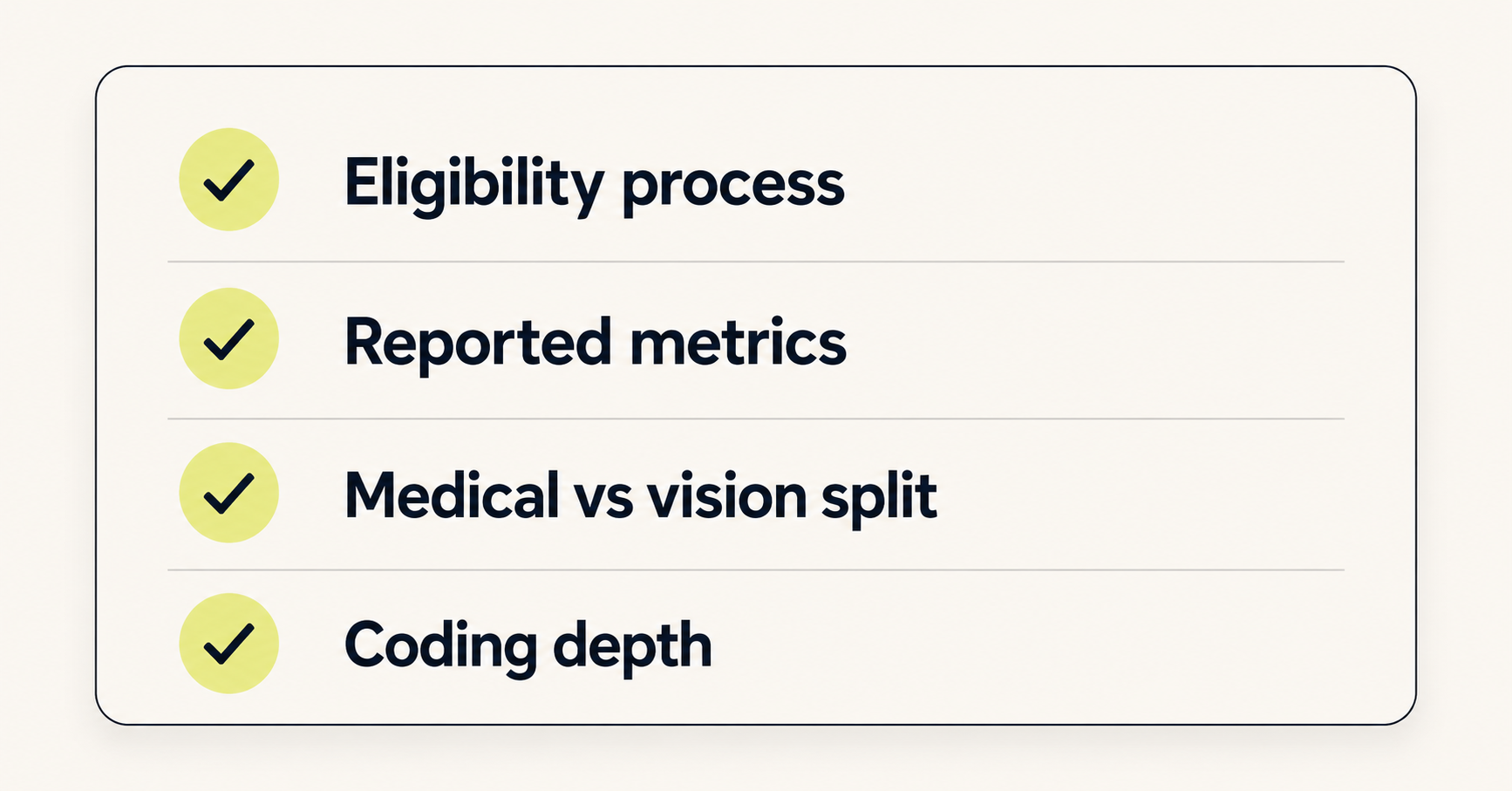
Start with eligibility, because the single biggest source of preventable denials is a benefit that was never verified. Ask exactly how and when coverage gets checked before the visit. Our walkthrough on how to verify patient insurance benefits covers what a real verification process looks like. Next, ask about the medical versus vision split specifically, because a service that cannot articulate how it decides which payer a visit belongs to will cost you on every dual-coverage patient.
Then look at the numbers they are willing to report. A serious partner will commit to metrics: net collection rate, first-pass acceptance, and days in AR. If they will not report on days in AR, it is usually because it is bad. It helps to understand the full cycle those numbers describe, which our primer on revenue cycle management lays out plainly. Finally, confirm coding depth. Eye care runs on a specific set of codes, and a service that does not know its CPT codes for exams, imaging, and materials cold is not really an optometry billing service. It is a general one wearing the label.
How much do optometry billing services cost
Outsourced optometry billing services are usually priced as a percentage of collections, with the commonly cited range falling around 4 to 9 percent depending on scope, practice size, and services included. A few charge per claim, and coding-only services may charge a flat monthly fee. In-house billing costs a salary plus benefits plus software, which for a full-time experienced biller lands well into five figures a year before you count the cost of coverage when they are out.
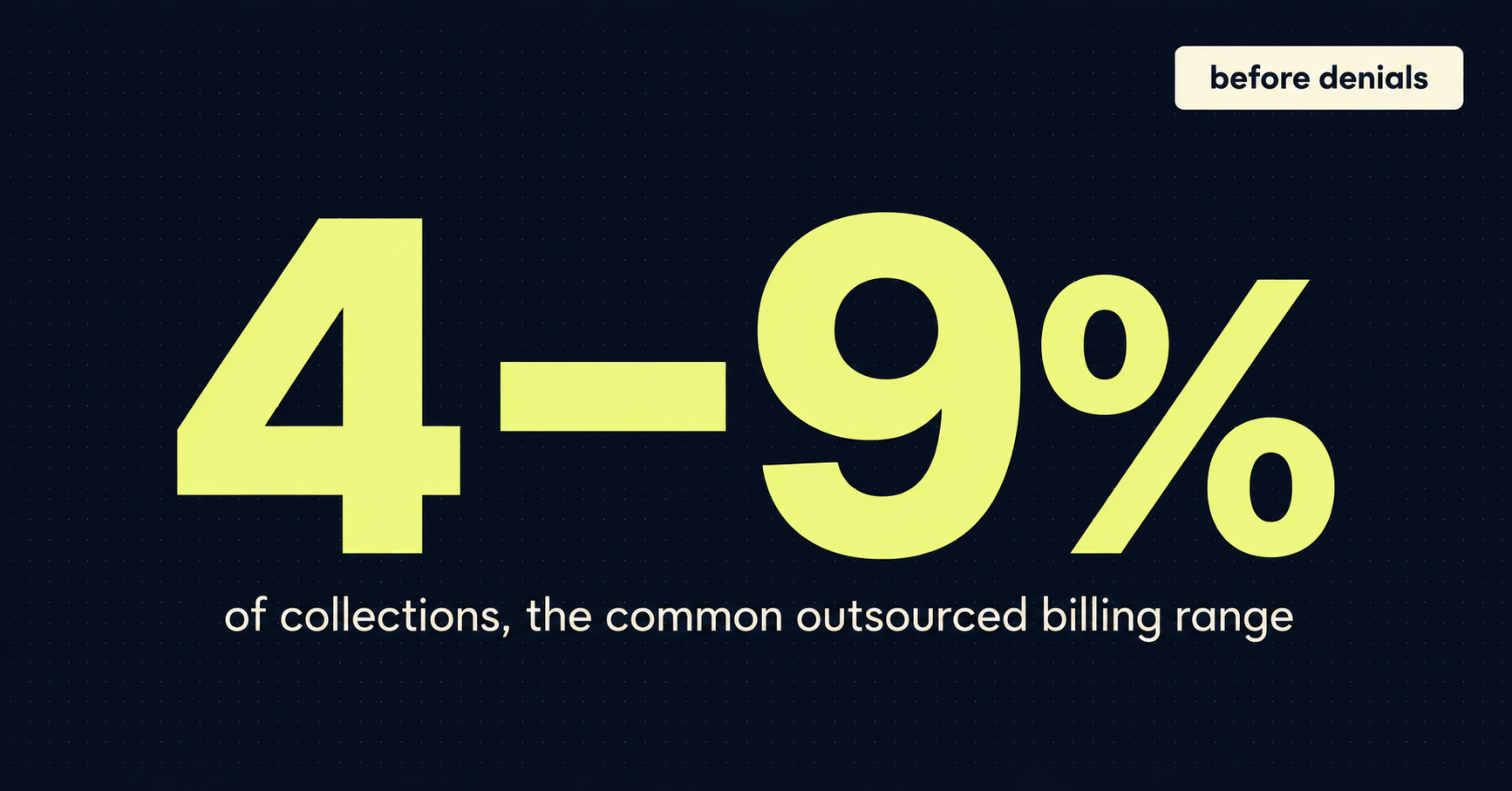
📊 KEY STAT Outsourced billing typically runs 4 to 9 percent of collections (Medical Billers and Coders, 2026). The fee is only half the math, though. The other half is the leakage a model leaves in place, and a cheap service that prevents nothing can cost more than a pricier one that stops denials early.
The number most practices forget to price is the cost of the denials themselves. Every reworked claim carries a labor cost to appeal, a delay in cash, and a real percentage that simply gets written off because chasing it costs more than it collects. When you compare models, the honest comparison is not just the fee. It is the fee plus the leakage the model leaves in place.
Outsource or automate? How to actually decide
Here is the decision most guides skip. Outsourcing and automating solve different problems, and treating them as the same choice is why practices overpay.
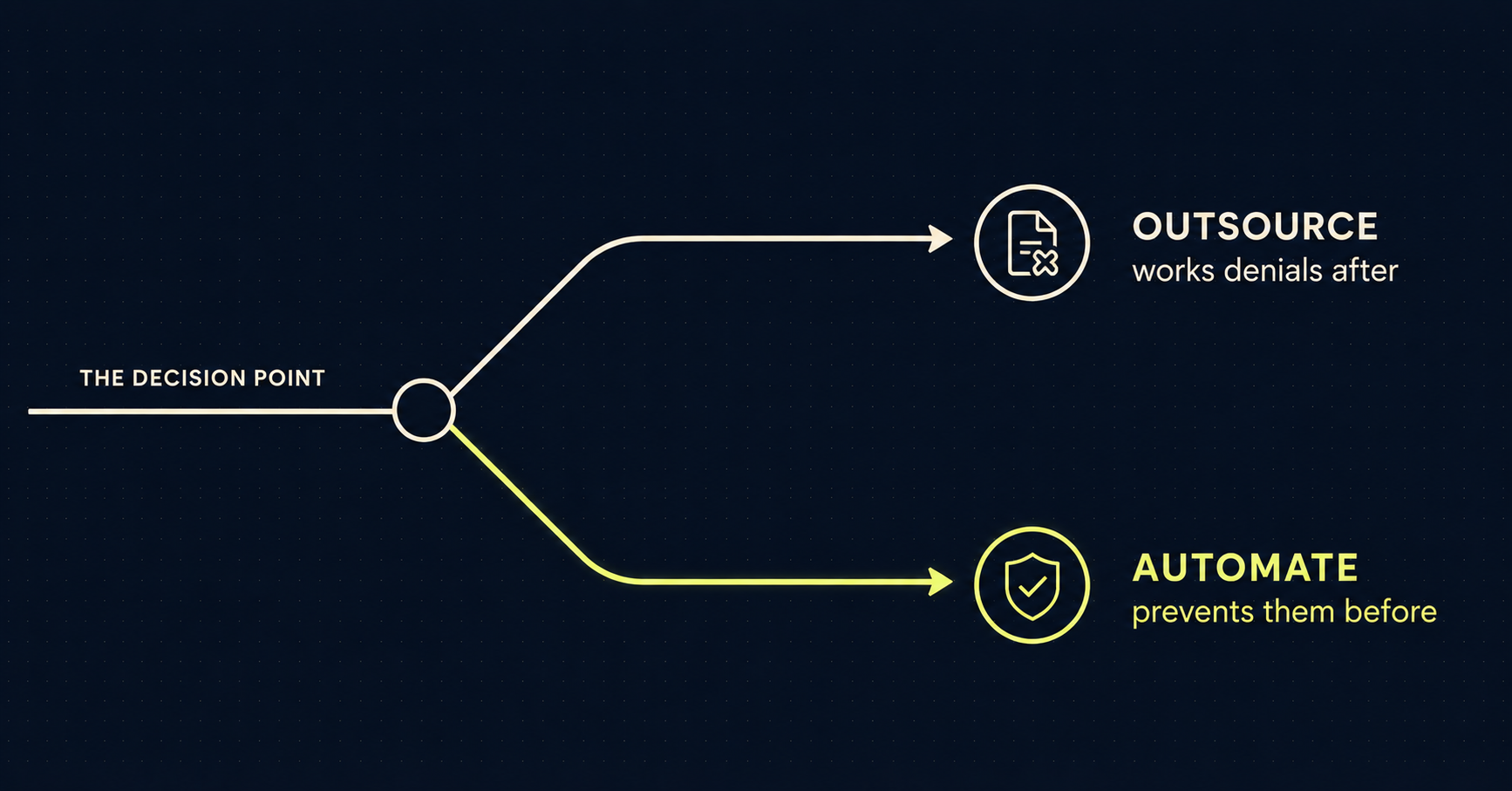
Outsourcing solves a labor problem. You do not have the people, or you do not want to manage them, so you rent a team. Automation solves a prevention problem, reducing the number of claims that need a team in the first place. If your denials mostly trace back to things that happen before submission, like the wrong payer, a missed eligibility check, or a coding decision made on autopilot at the front desk, then paying a percentage to work those denials afterward is paying to mop the floor instead of turning off the tap.
For most independent practices the strongest setup is not either-or. It is to automate the front of the cycle so clean claims go out the first time, and to keep a lean billing resource, in-house or outsourced, for the genuinely complex work that is left. That combination is what shrinks your denial pile and your billing spend at the same time. You can see how that pre-submission layer fits into a real workflow on our product overview, and the wider context lives in our pillar guide to optometry billing.
See it in your own practice.
GIMBL makes the payer and coding decision before the claim exists. Start your free trial and create your account →
Frequently asked questions
What is the difference between optometry medical billing and vision billing?
They are two separate systems, and the same patient can land on either one. Vision billing goes to a routine vision plan like VSP or EyeMed and covers exams, glasses, and contacts. Medical billing goes to the patient's major medical carrier and covers medical eye conditions like glaucoma, dry eye, or diabetic eye disease. Knowing which visit belongs to which payer is the core skill of optometry billing, and it is where most avoidable losses happen.
Does medical insurance cover optometry?
Yes, but only the medical side of eye care. A visit for a medical complaint or condition, such as an infection, injury, or disease, is generally billable to medical insurance. A routine refractive exam for glasses usually is not, and typically falls to a vision plan or the patient. What decides it is the reason for the visit and the diagnosis, not the type of provider.
Should a small optometry practice outsource billing?
It depends where the pain is. If the problem is that no one has time to work claims, outsourcing helps immediately. If the problem is that too many claims are being created wrong in the first place, automation that prevents denials before submission will usually do more, and often costs less, than paying a percentage to chase them afterward.
How much do optometry billing services cost?
Outsourced services typically charge somewhere in the range of 4 to 9 percent of collections. In-house billing costs a salary plus software. Pre-submission automation is usually a predictable subscription rather than a cut of revenue, which is why it pairs well with either of the other two.